Is Laser Engraving Profitable? Real Costs & Margins
What the margins actually are once you count your own time, which products carry a business, why most laser businesses stall, and how to work out your real break-even.
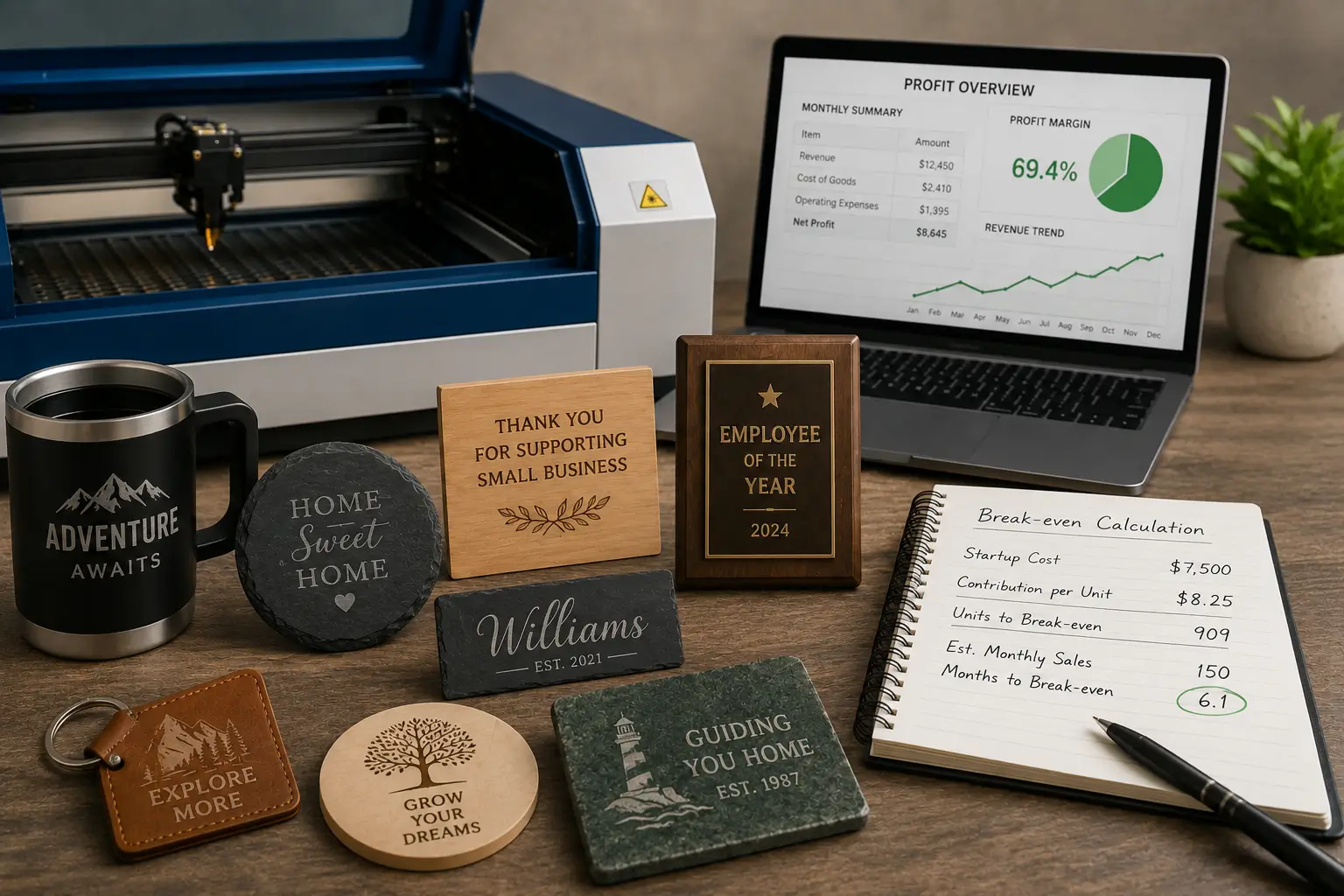
Yes, laser engraving can be profitable, and the margins on materials are genuinely high. A slate coaster costing a few dollars sells for well over ten. But material margin is not business margin. Once you account for design time, machine time, finishing, packaging, platform fees and your own hourly rate, the picture changes considerably. The businesses that work are the ones that stop selling one-off custom pieces and move toward repeat and batch orders, because design time is the cost that quietly eats the profit on custom work. The machine is rarely what limits a laser business. Pricing and product mix are.
Key takeaways
- Material margins are high; business margins are moderate. Raw material on most engraved products is a small fraction of the sale price, but design, setup, finishing and packaging time is what actually determines whether a job made money.
- Design time is the profit killer on custom work. Twenty minutes of artwork on a single ten-dollar item wipes out the margin. The same twenty minutes across a batch of fifty is negligible.
- Repeat and B2B work is where laser businesses become sustainable. Corporate awards, school plaques, industrial marking and trade accounts reorder, which means the setup cost is spread and demand is predictable.
- Seasonality is severe. Personalisation is heavily weighted toward the run-up to Christmas and gifting seasons. Plan cash flow around that rather than assuming even monthly revenue.
- The machine is rarely the constraint. Most businesses that stall do so because of pricing, product mix or marketing, not because the laser could not keep up.
Almost every article on this question answers yes and moves straight to a list of things you could make. That is not wrong, but it is not much use either, because the interesting question was never whether anyone has made money engraving. Plenty have. The question is what the economics actually look like, and where they break down.
This guide takes the less flattering angle: what the margin looks like after all the costs, why the same product can be profitable in one business and a loss in another, and what tends to separate the shops that grow from the ones that stall at a few hundred dollars a month.
The Short Answer, and the Honest Caveat
Laser engraving has genuinely attractive economics on paper. Raw materials are cheap relative to what personalised goods sell for, the machine is a one-off capital cost rather than a per-unit cost, consumables are minimal, and there is no inventory risk if you make to order.
The caveat is that those attractive numbers describe the material margin, not the business margin. A blank slate coaster might cost two dollars and sell engraved for twelve. That looks like an enormous markup until you count the twenty minutes you spent on the customer's artwork, the failed first attempt, the packaging, the marketplace fee and the time answering three emails about font choices.
This is not a reason to avoid the business. It is the reason to price properly and choose products deliberately, which is what the rest of this article is about.
The Unit Economics of a Single Job
The most useful thing you can do before starting is model one realistic job end to end. The numbers below are illustrative rather than a promise, but the structure is what matters. Fill in your own figures.
Take a set of four engraved slate coasters sold for a typical retail price.
Cost Line | Typical Treatment | Why It Gets Missed |
|---|---|---|
Blank material | Easy to count, usually small | Everyone counts this |
Consumables and wear | Small per unit; lens, filters, tube life | Real but rarely allocated per job |
Machine time | Minutes per piece at your machine's hourly cost | Most makers treat machine time as free |
Design and setup time | Often the largest single input on custom work | Almost never billed on one-off jobs |
Failed pieces | A percentage of output, higher when learning | Written off mentally rather than costed |
Finishing | Colour fill, cleaning, sealing, assembly | Adds real minutes per piece |
Packaging and shipping materials | Small but per-unit | Underestimated on fragile goods |
Platform and payment fees | A percentage of the sale on marketplaces | Comes off the top before you see it |
Your own hourly rate | The one that decides if this is a business | Frequently set to zero |
Run that on a single custom order and the margin is often thin. Run the same product as a batch of twenty with one design setup and no bespoke artwork, and it becomes genuinely good. That difference is the whole business model.
The most common costing mistake: Pricing at material cost plus a markup, and treating your own time as free. It produces a number that feels competitive and a business that cannot pay you. If your pricing does not include an hourly rate for yourself, you are running a hobby that occasionally reimburses expenses.
What Actually Makes Money
Products vary enormously in how well they hold margin once time is counted. The pattern is consistent: anything that repeats, batches, or carries emotional value holds margin. Anything that requires bespoke artwork for a single low-value item does not.
Category | Margin Behaviour | Why |
|---|---|---|
Corporate awards and recognition | Strong | Repeat annual orders, batch setup, price insensitivity |
Industrial part marking and traceability | Strong | Contract work, high volume, technical barrier to entry |
School and club plaques | Strong | Predictable annual cycle, batch production |
Wedding and event orders | Strong | One design, many units, high perceived value |
Memorial and pet memorial | Strong | High emotional value, low price sensitivity |
Branded merchandise for local business | Strong | Repeat orders, logo reused across products |
Coated drinkware | Good | Fast, popular, batches well; competitive |
Signage and address plaques | Good | Higher ticket, moderate setup |
Personalised gifts, general | Mixed | Depends entirely on whether artwork repeats |
One-off fully custom pieces | Weak | Design time per unit destroys the margin |
Low-price marketplace commodity items | Weak | Competing on price against sellers who do not cost their time |
For more ideas on what you can sell, see our guide to laser engraving business ideas.
Notice how many of the strong categories are business customers rather than consumers. That is not a coincidence, and it is the single most useful pattern in this industry. You can also explore specific profitable laser engraved products and how they can fit into your product mix.
Why B2B Changes the Economics
Consumer personalisation is where most people start, because it is visible, it is fun, and the market is obvious. It is also where margin pressure is worst: every job needs new artwork, every customer is new, and you are competing on price against a marketplace full of sellers who have not costed their own time.
Business customers behave differently in four ways that all favour you.
They reorder. A company that buys recognition awards buys them again next year with the same logo. The design work is done once and amortised across every future order.
They order in quantity. Setup time per unit collapses on a run of fifty. This is the single biggest lever on margin available to you.
They are less price sensitive. A business buying twenty awards is comparing you against the hassle of finding another supplier, not against the cheapest listing on a marketplace.
They pay on terms and plan ahead. Predictable revenue is worth more than the same total revenue arriving unpredictably.
The practical implication is that the fastest route to a sustainable laser business is usually not more consumer marketing. It is finding three or four local businesses, schools or clubs that need something engraved every year and becoming their supplier.
What You Actually Need to Start
The machine dominates the startup budget, but it is not the only line, and the extras catch people out. Choosing the right laser engraving machines is therefore one of the most important decisions before you invest.
Item | Necessity | Notes |
|---|---|---|
Laser machine | Essential | The largest single cost. Match the type to your intended products, not to price alone |
Fume extraction | Essential | Not optional for indoor operation or for machine longevity |
Design software | Essential | Budget for a licence; free tools work but slow you down |
Computer | Essential | Most engraving software is not demanding |
Initial material stock | Essential | Start narrow. Do not buy a range you have not sold yet |
Rotary attachment | Situational | Required for tumblers, bottles and cylindrical work |
Business registration and insurance | Essential | Cost varies by state and structure |
Website or storefront | Important | Can start minimal and grow |
Photography setup | Underrated | Product photos sell personalised goods; poor photos cost you sales |
Packaging | Ongoing | Fragile goods need real packaging; factor it per unit |
On the machine itself, the biggest financial mistake is buying for price rather than for the products you intend to sell. A cheap machine that cannot process your intended materials is not a saving.
Working Out Your Break-Even
Rather than looking for someone else's payback period, calculate your own. The arithmetic is simple.
1. Total your startup cost. Machine, extraction, software, initial stock, registration, everything.
2. Work out your true contribution per unit. Sale price minus materials, consumables, fees, packaging and the labour time you actually spend. Not sale price minus material cost.
3. Divide. Startup cost divided by contribution per unit gives the number of units to break even.
4. Sanity check against your capacity. How many of those can you realistically make and sell per month alongside everything else in your life? That converts units into months.
This exercise is worth doing honestly before purchase, because it surfaces the real constraint. For most people it is not machine speed. It is how many orders they can generate and how much time they have to fulfil them.
Why Laser Businesses Stall
This is the part most articles on the subject leave out. The failure modes are consistent and mostly avoidable.
Pricing on material cost. Covered above, and it is the most common single cause. Businesses that price this way stay busy and never become profitable.
Saying yes to everything. Every unusual one-off request costs design time, test material and learning. A shop that accepts all work never builds the repeatable products that carry margin.
Competing on price in a commodity market. There is always someone listing engraved keychains cheaper, often because they are not costing their labour. That is not a market you win by matching them.
Underestimating the non-engraving work. Customer communication, artwork preparation, proofing, photography, listings, packing and shipping typically take longer than the engraving itself.
Buying the wrong machine. A machine that cannot process the materials your intended customers want limits the business permanently, and switching later means buying twice.
No repeat revenue. A business made entirely of new customers has to win every sale from scratch. Without repeat or contract work, growth stalls at the limit of your marketing effort.
Ignoring seasonality. A large share of personalisation revenue lands in the weeks before Christmas. Businesses that do not plan capacity and cash flow around that peak either miss the revenue or drown in it.
A Pricing Method That Works
Set a price floor from cost, then a price ceiling from value, and sell somewhere between the two.
The floor. Materials, plus consumables, plus machine time at an hourly rate you have calculated, plus your own labour at an hourly rate you would accept, plus fees and packaging, plus an allowance for failed pieces. Below this number you are losing money, whatever the market says.
The ceiling. What the item is worth to the buyer. A personalised memorial piece and a plain engraved keyring may take similar machine time, but nobody prices them the same, because the buyer is not purchasing minutes of laser time. They are purchasing the finished meaning.
Charge separately for design. Either bill artwork time as a line item, or build a set of templates that customers choose from. Custom artwork given away free is the most common invisible loss in this business.
Price batches differently from singles. Setup cost is per job, not per unit. Your pricing should reflect that, both to make batches attractive to customers and to stop single custom pieces losing money.
Seasonality and Cash Flow
Personalisation is a seasonal business. Gifting seasons, weddings, graduations and the run-up to Christmas concentrate demand into a few periods, and it is common for shops to earn a disproportionate share of annual revenue in the final quarter.
Two practical consequences. First, capacity planning matters more than average monthly throughput suggests, because you need to survive the peak rather than the average. Second, the quiet months are when you should be building B2B relationships and producing stock of your repeatable products, not waiting for orders.
Scaling Beyond One Person and One Machine
Most laser businesses hit a ceiling that is not about demand. It is that one person can only design, engrave, finish, pack and ship so many orders.
The routes past it are limited and worth knowing early. You can raise prices and take less work at better margin. You can shift the product mix toward batch and contract work so each hour produces more units. You can add a second machine so engraving is no longer the bottleneck. Or you can hire, which usually means standardising your products enough that someone else can make them.
Adding a machine before fixing pricing is the wrong order. A second laser doubles your capacity to produce work that may not have been profitable in the first place.
Profitability becomes real only when the price covers the whole job. Use our laser engraving pricing guide to turn material, machine, and setup costs into a sustainable quote.
The Realistic View
Laser engraving is a good business with real margin available, and it is not passive income. The machine does the engraving in seconds; the business is everything around it, which is design, customer communication, pricing, finishing and finding the customers who reorder.
If you are still deciding, do two things before you buy anything. Model one realistic job end to end with your own numbers and your own hourly rate, and identify three local businesses, schools or organisations that already buy engraved items from somebody. Those two exercises will tell you more about whether this works for you than any market growth statistic. And if you are weighing which machine, our guide to CO2 vs fiber lasers covers matching the technology to the products you actually intend to sell.
Frequently asked questions
Is laser engraving actually profitable?
Yes, but the margin depends far more on product mix and pricing than on the engraving itself. Material costs are low relative to selling prices, which makes the headline margins look excellent. Businesses become genuinely profitable when they move toward repeat, batch and business customers, because that spreads design and setup time across more units.
How much can you make with a laser engraver?
It ranges from pocket money to a full income, and the variable is rarely the machine. The determining factors are what you sell, whether the work repeats, and whether you price to include your own time. Two people with identical machines can have completely different outcomes.
What is the most profitable laser engraving product?
Anything that repeats. Corporate awards, industrial part marking, school plaques and event orders hold margin because one design serves many units and the customer returns. One-off fully custom items are the least profitable, because design time cannot be spread.
How long does it take to pay off a laser engraver?
Calculate it rather than relying on someone else's figure. Divide your total startup cost by your genuine contribution per unit, then divide by how many units you can realistically make and sell each month. The honest answer depends on your sales capacity, not the machine.
Do I need a business licence to sell laser engraved products?
Requirements vary by state and by how you sell, but registering a business is worth doing early. It affects liability, taxes, banking and your ability to sell to corporate customers, many of whom will not buy from an unregistered supplier. Check your state's requirements.
Is the laser engraving market too saturated?
The consumer end of it is crowded, particularly the low-price marketplace segment. The business-to-business end is considerably less so, because it requires reliability, invoicing and consistency rather than just a machine. Saturation is real where the barrier to entry is lowest.
Can I run a laser engraving business part time?
Yes, and many do. The constraint is that fulfilment time scales with orders, so part-time capacity caps revenue. Part-time businesses tend to do better focusing on higher-value, lower-volume products rather than high-volume low-margin ones.
What is the biggest mistake new laser businesses make?
Pricing on material cost and treating their own time as free. It produces prices that feel competitive, keeps you constantly busy, and never generates a profit that could pay a wage or fund a second machine.