Are Laser Engravers Dangerous? A Complete Safety Guide
Why the enclosure matters more than the wattage, which hazard actually causes most incidents, and what the law requires in a workplace.

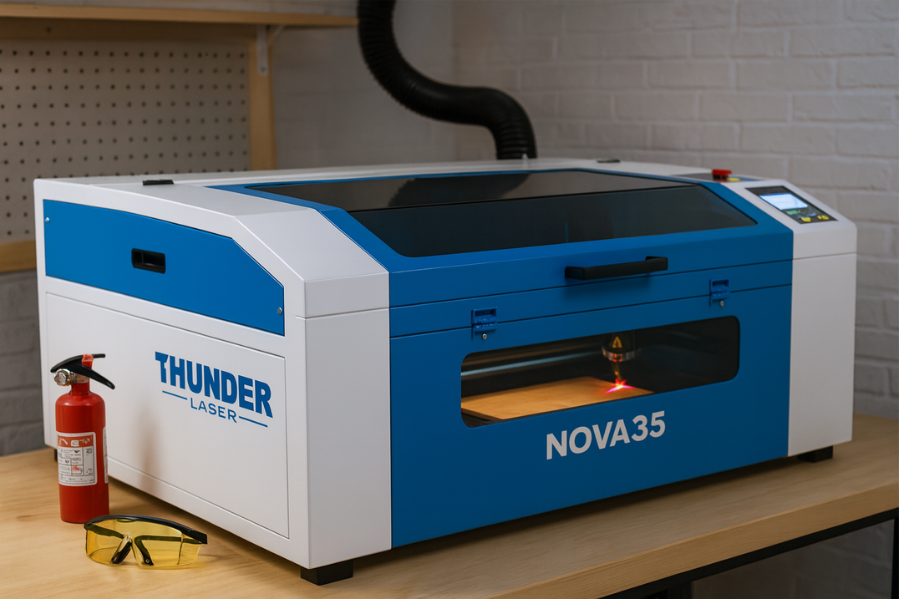
Quick answer: A laser engraver is as dangerous as its enclosure allows it to be, and that has almost nothing to do with power. A fully enclosed, interlocked machine is a Class 1 laser system and needs no eye protection during normal use, even with a 100W Class 4 source inside it. An open-frame machine with no enclosure is Class 4 and requires rated glasses, a controlled area and, in a workplace, a designated Laser Safety Officer, even at 10W. The hazard that actually causes most incidents is not eye injury but fire, which is why the single most important rule is never leaving a running machine unattended.
Key takeaways
- Classification depends on accessible emission, not source power. OSHA's own technical manual confirms that a high-power laser fully enclosed with interlocks meets all the requirements of a Class 1 system.
- A 10W open diode can be more hazardous to stand near than a 100W enclosed CO2. One has an accessible beam and the other does not. Ranking machines by wattage gets this exactly backwards.
- Fire is the incident that actually happens. Eye injuries dominate the discussion and unattended fires dominate the insurance claims. Never leave a running machine.
- Defeating an interlock converts a Class 1 machine into a Class 4 one. Taping the lid switch so you can watch the cut is the single most common way people get hurt.
- Class 3B and Class 4 trigger real obligations at work. ANSI Z136.1 requires a designated Laser Safety Officer, written procedures and a controlled area. Class 1 systems require none of that.
Laser engravers get discussed as though danger scales with wattage. It does not. A 150W machine in a sealed cabinet is safer to stand next to than a 10W diode sitting open on a bench, and understanding why is the whole of laser safety.
This guide covers what the hazards actually are, which ones cause real incidents, and what the standards require once you are operating in a workplace rather than a garage.
Laser Classes: The Thing That Actually Determines Risk
Every laser product carries a class from 1 to 4. The class is based on the radiation a person can actually be exposed to, not on how powerful the source is.
A Class 4 laser inside a sealed, interlocked cabinet is a Class 1 system. This is the central fact and it is stated plainly in OSHA's technical manual: the most common form of a Class 1 laser system is a high-power laser totally enclosed inside a protective housing with interlocks on every removable panel. Such a system meets all the requirements of Class 1 and may be operated with no additional controls for the operator. Nearly every professional CO2 and fiber cabinet works this way. The source inside is Class 4. The machine you stand in front of is Class 1. |
Class | What It Means | What Is Required |
|---|---|---|
Class 1 | No accessible hazardous radiation under normal use | Nothing. No eyewear, no controlled area, no training requirement |
Class 1 system | A higher-class laser fully enclosed and interlocked | Same as Class 1 in normal use. Controls return during service |
Class 3R | Low risk, brief exposure unlikely to injure | Training recommended, avoid direct viewing |
Class 3B | Hazardous on direct or specular exposure | Rated eyewear, controlled area, LSO required in a workplace |
Class 4 | Hazardous from direct, reflected and diffuse exposure | Rated eyewear, controlled area, written SOP, LSO, signage |
Most hobby diode machines are open-frame with no enclosure, which puts them at Class 4 or Class 3B regardless of their modest wattage. Most professional CO2 and fiber machines are enclosed cabinets with lid interlocks, which makes them Class 1 systems.
This inverts the intuition that a bigger machine is more dangerous. It is not. A less contained machine is more dangerous.
Fire Is the Hazard That Actually Happens
Almost every discussion of laser safety opens with eye injury. In practice, the incident that occurs in real workshops is a fire, and it happens for a predictable set of reasons.
The material flares. Acrylic, thin wood, paper, cardboard and fabric can all ignite rather than cut, particularly when the speed is too low or the power too high for the thickness.
Debris builds up under the bed. Offcuts and dust in the honeycomb and the tray are exactly the fuel a dropped flare needs. The most common fire does not start in the workpiece; it starts in the scrap underneath it.
The machine was left running. A flare that is spotted in two seconds is a non-event. The same flare discovered after a coffee break is a workshop fire. This is the single most important rule in laser operation and it is routinely ignored on long jobs.
Air assist was off or too weak. Air assist clears the combustion products and cools the cut. Running without it on a cutting job substantially raises fire risk.
What to have ready: a CO2 or clean-agent extinguisher within reach, not a powder one, because powder will destroy the optics and the machine along with the fire. Keep the lid closed; a closed enclosure starves a small fire of oxygen. And clean out the bed regularly, which our CO2 laser engraver checklist covers as routine practice.
Eye Safety, and Why the Enclosure Beats the Glasses
A CO2 beam at 10,600 nm and a fiber beam at 1,064 nm are both invisible. You cannot see them coming and there is no blink reflex to protect you. Both can cause permanent retinal or corneal damage from direct or reflected exposure.
The engineering control outranks the personal one. Safety glasses are the last line of defense, not the first. A properly enclosed machine with a working lid interlock means the beam cannot be emitted while anything is open, which is a far more reliable protection than relying on someone remembering eyewear.
Glasses must match the wavelength. Eyewear rated for 1,064 nm does nothing against a 10,600 nm CO2 beam and vice versa. Check the wavelength and the optical density marked on the frame, and treat anything unmarked as decorative.
Never defeat an interlock. Taping over the lid switch so you can watch the cut, or running with a panel removed, converts a Class 1 machine into a Class 4 one in a single action. It is the most common way people are actually injured by industrial lasers, and it is entirely self-inflicted. If you need to watch the job, watch it through the window the machine was designed with. |
Fumes: What Is Actually in Them
Every material a laser processes produces something you should not breathe. The question is what, and how bad.
Ordinary materials still produce respirable particulate. Wood, leather, paper and acrylic all generate fine particles small enough to reach deep into the lungs, plus volatile compounds. Acrylic releases methyl methacrylate, MDF releases formaldehyde from the adhesive, and wood smoke is wood smoke.
Some materials produce specific, named hazards. PVC releases chlorine, which forms hydrochloric acid in contact with moisture. ABS releases hydrogen cyanide from its acrylonitrile component. PTFE releases hydrogen fluoride. These are chemical hazards rather than nuisance smells, and no setting makes them acceptable.
Symptoms are a poor warning system. Headaches, throat irritation and nausea indicate exposure, but the most dangerous products are not always the most pungent. Treat extraction as a design requirement rather than something you add when the smell gets bad.
The complete material list is in our guide to materials that are not suitable for laser cutting and engraving, which separates the ones that ruin the job from the ones that are genuinely hazardous.
Extraction Done Properly
Extract at the source and vent outside where you can. Air should be pulled through the cabinet and away from the operator. A fan in the room moves contaminated air around; it does not remove it.
Filtered units need the right media for the job. HEPA captures particulate and does nothing for vapor. Vapor needs activated carbon, and carbon has a finite capacity that is consumed whether or not anyone is tracking it. A filter unit with exhausted carbon looks identical to a working one.
A mask is a supplement, never a substitute. If the only thing between you and the fumes is a respirator, the extraction is wrong. Fix the airflow first.
Check the ducting. Long runs, sharp bends and crushed flexible hose all cut airflow substantially. An extractor rated for the machine will still underperform through bad ducting.
Materials That Are Dangerous
Never laser: PVC and vinyl, PTFE and Teflon, polystyrene and styrene foam, and anything you cannot positively identify. PVC is the one that does lasting damage, because the acid attacks the machine's rails, optics and electronics from the inside long after the job.
Avoid on a thermal laser: ABS, because of the hydrogen cyanide, and polycarbonate, which melts, soots the optics and releases BPA.
Handle with proper extraction: MDF for formaldehyde, fiberglass, carbon fiber, whose dust is also electrically conductive and can short electronics, and chrome-tanned leather.
Generally straightforward: solid wood, plywood with known adhesive, cast acrylic, paper, cardboard, natural leather, glass, stone and bare metals on the right laser type. Straightforward still means extraction.
Is It Safe to Use at Home?
Yes, with the same conditions that apply anywhere. The machine should be an enclosed Class 1 system with working interlocks. Extraction should vent outside or run through a filter unit with current media. An extinguisher should be within reach. And the machine should never run unattended.
Two domestic-specific points. Children and pets should not have access to the work area, and a laser in a shared living space needs the extraction solved properly rather than approximately, because the exposure is continuous rather than confined to a shift.
Our guide on how to laser engrave safely at home covers the domestic setup in more detail.
What the Standards Require in a Workplace
ANSI Z136.1 is the governing laser safety standard in the United States. OSHA has no laser-specific standard of its own and enforces through the General Duty Clause, citing employers whose laser safety programs are inadequate.
For Class 1 systems, the obligations are minimal. ANSI Z136.1 does not require employer safety programs or employee training programs for Class 1 systems that do not contain embedded higher-class lasers accessible during normal use. This is the main practical benefit of buying an enclosed machine.
For Class 3B and Class 4, the obligations are substantial. The standard requires the institution to designate a Laser Safety Officer with authority to approve procedures and use areas and to suspend operation of any laser presenting an uncontrolled hazard. It also requires laser safety training for users, a written standard operating procedure, a controlled area with access control, and appropriate signage.
Service is when a Class 1 machine stops being one. Classification covers normal operation, not servicing. Opening the housing for alignment or mirror replacement exposes the beam, and that work needs the Class 4 controls: trained personnel, rated eyewear, and a controlled area.
Risk by Machine Type
Ranked by what actually determines risk, which is containment rather than wattage.
Machine | Typical Classification | Why |
|---|---|---|
Enclosed CO2 cabinet, 40 to 150W | Class 1 system | Sealed housing, lid interlock, beam cannot be accessed in use |
Enclosed fiber marker, 20 to 100W | Class 1 system | Same containment. Source is Class 4; the system is not |
Open-frame diode, 5 to 40W | Class 4 or 3B | No enclosure, accessible beam, visible wavelength reflects readily |
Open-frame CO2 or galvo | Class 4 | Accessible beam, invisible wavelength, no blink reflex |
Handheld cleaning or welding laser | Class 4 | Beam deliberately accessible. Highest practical operator risk |
Any machine with a defeated interlock | Class 4 | The enclosure is the classification. Remove it and the class changes |
Safety Equipment Worth Having
An enclosed machine with working interlocks. The single most effective safety measure available, and the one that removes the need for most of the others.
Extraction rated for the machine, vented outside or filtered properly. Not optional on any material.
A CO2 or clean-agent extinguisher within arm's reach. Powder will put the fire out and destroy the machine.
Wavelength-matched safety glasses. Essential on open-beam machines, and worth owning even with an enclosed one for service work.
A smoke detector in the room. Cheap, and it covers the gap between you leaving and you returning.
A maintenance routine. Clean optics, aligned mirrors and a clear bed are safety items as much as quality items, and our laser engraver maintenance guide sets out the schedule.
The Short Version
Buy enclosed. An interlocked cabinet does more for your safety than every other measure combined, and it is the difference between a machine that needs eyewear, signage and a safety officer and one that needs none of them.
Then extract properly, keep an extinguisher within reach, clean the bed out, and never walk away from a running job. Those four habits cover the overwhelming majority of what actually goes wrong.
And never defeat an interlock. Every protection the machine offers rests on the enclosure being intact. Our guide on settings for wood cover the day-to-day habits, and if you would rather see a Class 1 machine running before deciding, book a demo.
Frequently asked questions
Are laser engravers dangerous?
They can be, and the deciding factor is containment rather than power. A fully enclosed, interlocked machine is a Class 1 system and needs no eye protection in normal use even with a Class 4 source inside. An open-frame machine is Class 4 and needs rated eyewear, a controlled area and, in a workplace, a Laser Safety Officer, regardless of how modest its wattage is.
Do I need safety glasses for an enclosed laser engraver?
Not during normal operation of a Class 1 system, because the enclosure and interlocks prevent any accessible emission. You do need them for service work with the housing open, and you need them at all times on an open-frame machine. Glasses must match the wavelength: 1,064 nm eyewear does nothing against a 10,600 nm CO2 beam.
Is it safe to watch a laser engraver working?
Through the machine's own viewing window, yes, because the window is part of the certified enclosure. What is not safe is opening the lid or defeating the interlock to watch, which converts a Class 1 system into a Class 4 one instantly.
Do you need ventilation for a laser engraver?
Always, for every material. Even wood and acrylic produce fine respirable particulate and volatile compounds. Extract at the source so air is pulled through the cabinet and away from you, and vent outside where possible. HEPA media catches particulate; vapor needs activated carbon, which has a finite life.
Should you wear a mask when laser engraving?
A mask is a supplement and never a substitute for extraction. If a respirator is the only thing between you and the fumes, the ventilation is inadequate and that is what needs fixing. For service work such as cleaning out a bed full of fine dust, a mask is sensible in addition to working extraction.
What is the most common laser engraver accident?
Fire, by a wide margin. Material flaring, debris igniting under the bed, and the machine being left running are the usual sequence. Eye injury dominates the discussion and unattended fires dominate the actual incidents, which is why not leaving a running machine is the most important single rule.
Can laser fumes make you sick?
Yes. Short-term effects include eye and throat irritation, headaches and nausea. Repeated exposure without adequate extraction is associated with respiratory problems. Specific materials produce specific hazards: PVC releases chlorine, ABS releases hydrogen cyanide, and PTFE releases hydrogen fluoride.
Are laser engravers safe for home use?
Yes, under the same conditions as anywhere: an enclosed Class 1 machine with working interlocks, extraction vented outside or properly filtered, an extinguisher within reach, and never running unattended. In a shared living space, solve the extraction properly rather than approximately, because the exposure is continuous.
Do I need a Laser Safety Officer?
For a Class 1 enclosed system in normal use, no. ANSI Z136.1 requires an LSO for institutions operating Class 3B or Class 4 lasers, which includes open-frame machines and handheld units, and the LSO has authority to approve procedures and use areas and to suspend operation of an uncontrolled laser.
Are diode lasers safer than CO2 lasers because they are lower power?
No, and this is a common and consequential misunderstanding. Most hobby diode machines are open-frame with an accessible beam, which makes them Class 4 or 3B despite modest wattage. Most CO2 machines are enclosed cabinets, which makes them Class 1 systems. The open 10W machine demands more precautions than the enclosed 100W one.