Laser Cut Foam: Materials, Settings, and Safety
Which foams cut cleanly, which one will destroy your machine, and how to dial in settings for tool control inserts, packaging, and prototyping.

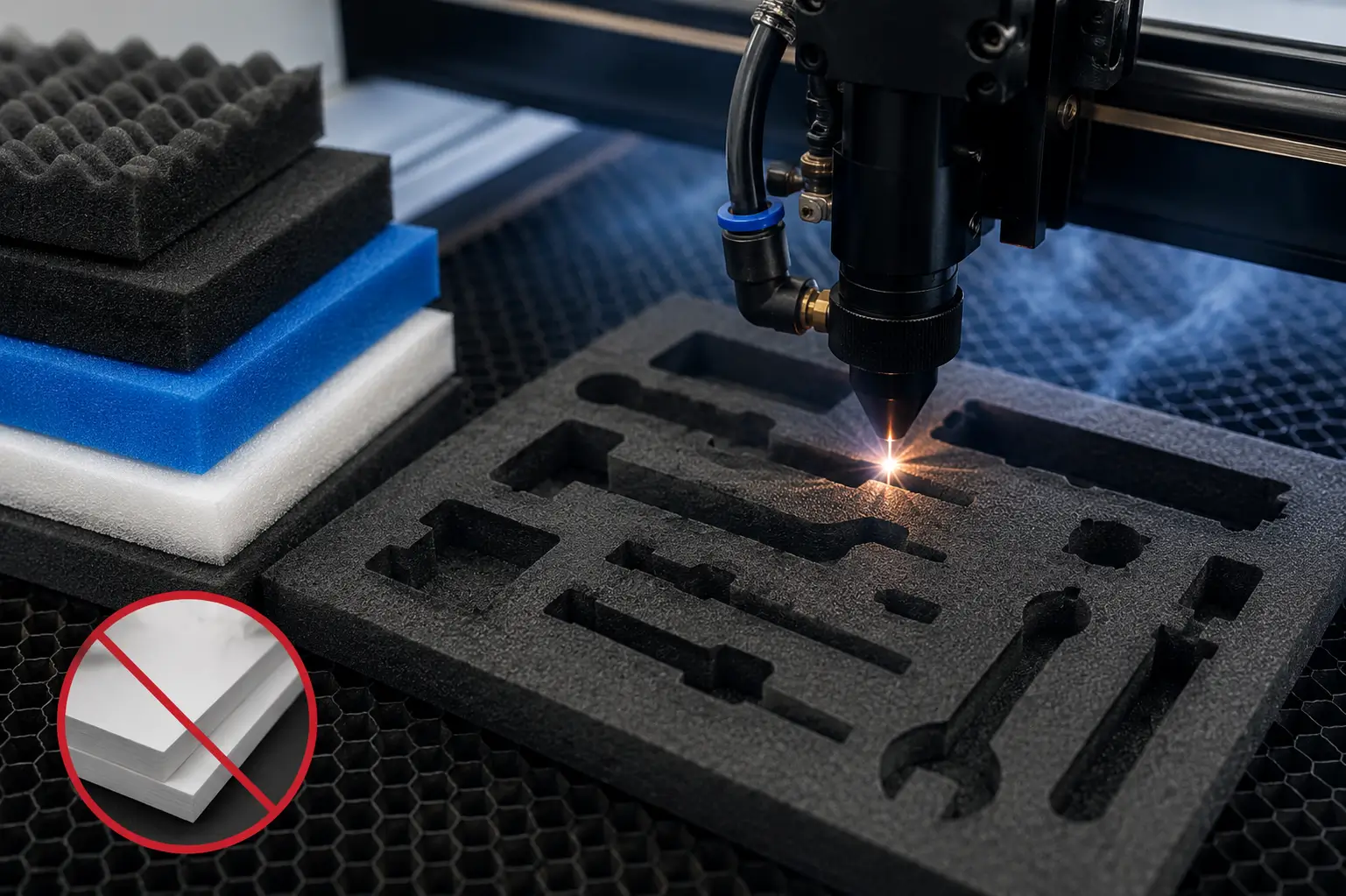
A CO2 laser cuts most foams cleanly and seals the edge as it goes. EVA, polyethylene, and polyurethane foam are all laser safe and are what most tool control inserts, case foam, and packaging are made from. PVC foam board is not — it releases hydrogen chloride that turns to acid inside your machine and corrodes the optics, rails, and electronics. Because PVC foam board is sold under names like Sintra and Forex and looks like ordinary foam, identify every sheet before it goes on the bed. For everything else, cut at high speed with low power, use air assist sparingly, and run real fume extraction.
Key takeaways
- Use a CO2 laser, not a fiber laser. Polymers absorb the 10.6 micron CO2 wavelength efficiently. Fiber is tuned for metal and will pass through or melt foam rather than cutting it.
- EVA, polyethylene, polyurethane, cross-linked PE and EPP are all laser safe. These cover almost all tool control, case insert and packaging foam.
- Never laser PVC foam board. Sold as Sintra, Forex, Komatex and similar, it releases hydrogen chloride that becomes acid inside the machine and corrodes optics, rails and electronics. Identify every sheet before it reaches the bed, because appearance tells you nothing.
- Cut fast at low power, not slow at high power. Foam needs far less power than its thickness suggests, and excess heat widens the kerf and shrinks the foam back from the cut line.
- Run real fume extraction. Foam has a high particulate load, and condensed vapour contaminates the focus lens quickly, degrading cut quality and eventually cracking optics.
Foam is one of the most rewarding materials on a CO2 laser. It cuts fast, it does not need clamping in the usual sense, the laser seals the edge as it passes, and the tolerances are tight enough that a wrench drops into its cutout with a satisfying fit. Tool control foam, custom case inserts, and protective packaging are all straightforward production work once the settings are dialled in.
It is also one of the few materials where getting the identification wrong can genuinely ruin a machine. That is worth covering first, because everything else in this guide assumes you have confirmed what you are about to cut.
The Foam That Will Damage Your Laser
Never laser PVC foam board. PVC is roughly 57 percent chlorine by weight. Heated by a laser it decomposes into hydrogen chloride and related chlorinated compounds, which combine with ambient moisture to form hydrochloric acid inside the machine. Ventilation does not solve this: the acid mist deposits on internal surfaces during the cut itself, before any exhaust system can clear it.
The damage is not theoretical and it is not gradual in the way most wear is. Acidic residue settles on mirrors and the focus lens, etches metalwork, attacks the linear rails and bearings, and gets into the electronics and motion control. Machines have been written off by a single job. Most manufacturers treat cutting PVC as a warranty-voiding event.
The health side is equally direct. Hydrogen chloride and chlorine compounds are respiratory irritants at low concentrations and dangerous at higher ones, which is why chlorine has a long history as a chemical weapon rather than a workshop byproduct.
What makes PVC specifically dangerous in a foam context is that it is sold as foam. PVC foam board trades under brand names including Sintra, Forex, and Komatex, and it sits on the shelf next to materials that are perfectly laser safe. It is rigid, lightweight, and visually indistinguishable from several harmless sheet materials. Someone searching for how to laser cut foam may well be holding a sheet of it.
How to Identify PVC Before It Reaches the Bed
Check the recycling mark. A triangle containing 3, or the letters PVC or V, means it does not go in the laser.
Ask the supplier for a safety data sheet. An SDS or material declaration settles it definitively. Reputable suppliers provide one on request.
Check the brand name. Sintra, Forex, Komatex, Palight, and Celtec are PVC foam board. If a product sheet says expanded PVC, closed-cell PVC, or foamed vinyl, it is the same material.
Never judge by appearance. Colour, stiffness, and surface finish tell you nothing. PVC foam board is routinely mistaken for acrylic and for polyethylene sheet.
When in doubt, do not cut it. An unidentified sheet is not worth a lens, a set of rails, and a service call. Route it, knife it, or wait for the SDS.
If you cut PVC by accident: Stop the job immediately and do not attempt to finish it. Run the exhaust at full for at least 30 minutes with the lid closed, then leave the area. Before using the machine again, inspect and clean the optics, bed, and interior surfaces following your manufacturer's guidance, and check for any corrosion on exposed metal. Treat it as a maintenance incident rather than a near miss.
Which Foams Are Laser Safe?
With PVC ruled out, most of the foam you are likely to encounter cuts well. This table covers the common types.
Foam | Also Called | Laser Safe? | Typical Use |
|---|---|---|---|
EVA | Ethylene-vinyl acetate, craft foam | Yes | Cosplay, gaskets, craft, case liners |
Polyethylene | PE, Plastazote, Zotefoam, closed-cell PE | Yes | Tool control, case inserts, packaging |
Polyurethane | PU, ester and ether foam | Yes | Upholstery, packaging, acoustic panels |
Cross-linked PE | XLPE, Volara | Yes | Medical, gaskets, fine detail work |
EPP | Expanded polypropylene | Yes | Impact packaging, RC models |
Depron | Extruded polystyrene sheet | With care | Model aircraft, architectural models |
Foam core board | Paper-faced foam board | Usually | Signage, prototyping, model making |
XPS / EPS | Polystyrene, Styrofoam | Caution | Models, signage; melts and can flare |
Polycarbonate foam | PC | No | Cuts poorly, discolours, fire risk |
PVC foam board | Sintra, Forex, Komatex, expanded PVC | Never | Do not laser under any circumstances |
On polystyrene specifically. Some guides list XPS and EPS as straightforward foam materials. They do cut, but polystyrene has a low melting point and a real tendency to melt back from the kerf and to flare. If you cut it, use the lowest power that will do the job, keep the speed high, and stay with the machine. It is not in the same category as PE or EVA.
On foam core board. The paper faces cut cleanly at low power. The core is usually polystyrene, which is fine with care. Check, though, that you have not been sold a PVC-cored board, which does exist.
Why a CO2 Laser and Not a Fiber Laser
This trips people up when they are choosing a machine, so it is worth being clear. A CO2 laser emits at around 10.6 microns, a wavelength that organic and non-metallic polymers absorb very efficiently. The energy is deposited right at the surface, the foam vaporises cleanly along the kerf, and the edge is sealed by the same heat that made the cut.
A fiber laser emits at roughly 1.06 microns, which is tuned for metal. Most polymers barely absorb it. On foam a fiber laser tends to pass through, scatter, or melt inefficiently rather than cutting a clean line. Fiber is the right tool for marking a metal tool that will sit in the foam. It is the wrong tool for the foam itself.
If your work is foam, packaging, and soft goods, a CO2 system is the machine to buy. If you also need to mark bare metal, that is a second machine or a dual setup rather than a compromise on one.
Settings and Technique
Foam behaves differently from wood or acrylic, and settings that work well elsewhere will make a mess of it. The overall principle is high speed and low power, which is close to the opposite of how most operators approach thick material.
Power and Speed
Foam has very low density and absorbs CO2 energy readily, so it needs far less power than its thickness suggests. Too much power melts the kerf wide, leaves a hard glazed edge, and can ignite the material. Start at the lowest power that reliably penetrates and increase in small increments.
Speed does more work here than power. A fast pass at modest power gives a narrow kerf and a soft sealed edge. A slow pass at high power dwells heat in one place, widens the kerf, and shrinks the foam back from the cut line, which is exactly what ruins a tight tool fit.
Symptom | Cause | Adjustment |
|---|---|---|
Kerf wider than expected | Too much power, or too slow | Reduce power first, then increase speed |
Edge hard and glassy | Excess heat glazing the surface | Reduce power, increase speed |
Foam shrinks back from the cut | Heat soaking into surrounding material | Faster pass, or split into multiple passes |
Not cutting through | Insufficient power for the thickness | Add a second pass rather than raising power |
Flare-ups during the cut | Power too high, or air assist feeding oxygen | Reduce power, reduce air pressure, never leave unattended |
Ragged or fuzzy edge | Underpowered, dragging rather than vaporising | Small power increase, check focus |
Cut narrows toward the bottom | Beam divergence through thick material | Longer focal length lens, or focus mid-thickness |
Air Assist, With a Caveat
Air assist is standard practice on most materials and it does help on foam by clearing vapour and keeping the lens clean. But foam is light and low density, and high-pressure air will lift thin sheets off the bed mid-cut, which ruins registration on a multi-part job.
Run air assist at lower pressure than you would for wood or acrylic. Enough to keep the optics clear and reduce flare risk, not enough to move the material. On very thin sheet, back it off further and hold the material down instead.
Holding Foam Flat
Foam is light, often slightly curled from being rolled or stacked, and easily displaced. A sheet that lifts even a few millimetres mid-cut goes out of focus and the cut quality collapses.
A honeycomb bed with a vacuum hold-down is the production answer and makes a visible difference on large sheets. Without one, weight the corners with something flat and heavy well clear of the cut path, or use low-tack tape at the edges. Magnets on a steel bed work if the sheet is large enough to reach them.
Focus and Thick Foam
A standard short focal length lens produces a tight waist and then diverges quickly, which is ideal for thin material and poor for thick. On foam over about a quarter inch, that divergence shows up as a cut that is clean at the top and tapered or ragged at the bottom.
A longer focal length lens gives a longer usable depth of field, keeping the beam effectively parallel through more material and producing a straighter wall. For thick foam this matters more than raw power. Focusing partway into the material rather than on the surface also helps balance the taper.
Cutting Thick Foam
Most CO2 systems will cut through one to two inches of soft foam in a single pass with the right lens and settings, and thicker with multiple passes. Beyond that, there are two practical approaches.
Multiple passes at lower power. Cleaner than one heavy pass and much less likely to melt or ignite. The cut walls stay straighter because you are not dumping all the heat in at once.
Layering thinner sheets. Cut several thinner sheets separately and stack them. This is standard practice for deep tool control inserts, and it has a real advantage: you can vary the cutout shape between layers to create stepped pockets and finger-lift reliefs that a single-depth cut cannot produce.
Fume Extraction Is Not Optional Here
Every laser job produces fumes. Foam produces a lot of them, and the particulate load is high because you are vaporising a material that is mostly air by volume and polymer by mass. Even fully laser-safe foams release ultrafine particulate and volatile organic compounds when they decompose.
Open windows and a room fan are not extraction. What you need is a system that pulls the fumes from the enclosure and either exhausts them outside or filters them properly, which for polymer work means particulate filtration plus activated carbon for the gas phase.
There is a machine-health argument alongside the health one. Foam residue and condensed vapour settle on the focus lens and mirrors, and a contaminated lens absorbs energy instead of transmitting it. That means degraded cut quality, more power to achieve the same result, and eventually a cracked lens. Good extraction plus regular optics cleaning is straightforwardly cheaper than replacing optics.
Thunder Laser machines pair with the Thunder Air fume extraction system, which is designed to handle exactly this kind of high-particulate polymer work.
What People Make With Laser Cut Foam
Tool Control and Shadow Foam
The largest commercial application, and the one that justifies a machine on its own for a lot of shops. Two-tone closed-cell polyethylene foam is cut so each tool sits in its own recess, usually with a contrasting colour layer underneath so an empty pocket is immediately visible.
This is standard practice in aviation maintenance, defence and law enforcement, motorsport, and any regulated environment where a tool left inside an assembly is a serious incident. It is also increasingly common in ordinary workshops that simply want a drawer that audits itself at a glance.
The laser is a good fit because the geometry comes straight from a scan or trace of the actual tools, cut lines can be arbitrarily complex at no extra cost, and repeat units are identical. A finger relief notch at the edge of each pocket, which is fiddly to produce by hand, is a two-second addition to the file.
Case Inserts and Protective Packaging
Custom inserts for instrument cases, camera equipment, medical devices, and shipping. Polyethylene and polyurethane both work; PE is firmer and holds a crisp pocket, PU is softer and more forgiving on delicate items. Both cut cleanly and seal at the edge, which matters for foam that will be handled repeatedly.
Cosplay, Props, and Prototyping
EVA foam is the backbone of prop and armour making, and a laser does in minutes what a craft knife does in an afternoon, with symmetry that is essentially free. Surface engraving at very low power adds panel lines, rivets, and texture without cutting through, which is difficult to do consistently by hand.
Acoustic and Technical Foam
Custom acoustic panels, gasket and seal blanks, and vibration isolation pads. Anywhere a specific profile is needed in quantity, cutting from a file beats templating and knife work on both speed and repeatability.
Architectural and Concept Models
Foam board and thin polystyrene sheet cut fast and cheaply for massing models and iteration. Low-power engraving marks fold lines and detail. This is high-volume, low-value work where laser speed pays off directly.
Workflow: A Tool Control Insert
1. Capture the tool outlines. Lay the tools on a flatbed scanner or photograph them squarely from directly overhead against a contrasting background, with a ruler in frame for scale.
2. Trace to vectors. Import the image into your design software and trace each outline with the pen or bezier tool. Automatic tracing is usually too noisy for a tight fit.
3. Add clearance. Offset each outline outward slightly. The right amount depends on the foam and how snug you want the fit, so establish it with a test cut rather than guessing.
4. Add finger reliefs. A small notch or scallop at the edge of each pocket makes tools easy to lift out. Skipping this is the most common complaint about home-made shadow foam.
5. Test cut one pocket. Cut a single tool outline in scrap of the same foam and check the fit before committing to a full sheet.
6. Cut the sheet. Secure the foam flat, confirm focus, run extraction, and stay with the machine.
7. Remove the plugs. Cut sections lift out cleanly from most closed-cell foam. If they resist, the cut has not fully penetrated and needs another pass.
Choosing a Laser for Foam Work
Consideration | What Matters for Foam | Why |
|---|---|---|
Laser type | CO2, not fiber | Polymers absorb 10.6 micron energy; fiber passes through |
Power | Moderate is plenty | Foam needs far less power than its thickness suggests |
Bed size | Larger than you think | Foam is sold in big sheets; small beds force seaming |
Lens options | Longer focal length available | Straighter walls through thick material |
Bed type | Honeycomb, ideally with vacuum | Light sheet material lifts and moves without hold-down |
Air assist control | Adjustable pressure | Full pressure lifts thin foam off the bed |
Extraction | Dedicated system, not a fan | High particulate load, and optics contaminate quickly |
Across the Thunder Laser CO2 range, bed size and lens options are usually the deciding factors for foam work rather than headline wattage. If most of your sheets are large, buying the bigger bed saves more time than buying more watts.
Foam is one of the materials where identifying the stock before cutting matters most. Review which materials are not suitable for laser cutting and engraving before testing unfamiliar foam, and see our CO2 vs. fiber laser guide for why CO2 is the appropriate technology.
Getting Started With Foam
Foam is fast, forgiving, and commercially useful, and it is one of the materials where a laser most obviously beats the alternatives. Tool control inserts in particular are steady, repeatable work that a lot of shops will pay for.
The discipline that matters is at the front of the process rather than the machine. Confirm what the material is before it goes on the bed, start at lower power and higher speed than instinct suggests, hold the sheet flat, and run real extraction. Get those four right and foam becomes one of the easiest materials you will run.
Frequently asked questions
Can you laser cut foam?
Yes. EVA, polyethylene, polyurethane, cross-linked PE, and EPP all cut cleanly on a CO2 laser, with the edge sealed by the cut itself. PVC foam board is the significant exception and must never be lasered.
What foam cannot be laser cut?
PVC foam board, sold as Sintra, Forex, Komatex and similar, must never go in a laser. Polycarbonate foam cuts poorly and discolours. Polystyrene can be cut but melts readily and carries a genuine flare risk, so treat it with care rather than as routine.
Why is PVC so dangerous in a laser?
PVC is around 57 percent chlorine. Heated, it releases hydrogen chloride, which forms hydrochloric acid with ambient moisture inside the machine. That acid attacks optics, metalwork, rails, and electronics, and the fumes are a respiratory hazard. Ventilation does not prevent it, because deposition happens during the cut.
What power do I need to cut foam?
Less than you would expect. Foam is low density and absorbs CO2 energy efficiently, so most work is done at low power and high speed. Excess power melts the kerf and glazes the edge. Start low and increase in small steps.
How thick a foam can a laser cut?
Most CO2 systems handle one to two inches of soft foam in a single pass with an appropriate lens, and more with multiple passes. Beyond that, cutting thinner sheets and stacking them is usually the better approach, and it allows stepped pockets that a single cut cannot produce.
Does laser cut foam smell or leave residue?
Yes, foam produces significant fumes and particulate. Proper extraction is required for both operator health and machine longevity, since condensed vapour contaminates the focus lens quickly and degrades cut quality.
Can I engrave foam as well as cut it?
Yes. At very low power a CO2 laser removes a shallow surface layer without penetrating, which is how panel lines, logos, and texture are added to cosplay armour and branded packaging inserts. Test settings carefully, since the margin between engraving and cutting through is narrow on soft foam.
Should I use air assist when cutting foam?
Yes, but at reduced pressure. Air assist keeps the optics clean and reduces flare risk, but full pressure will lift light foam sheets off the bed and ruin your registration. Dial it back from your wood and acrylic settings.