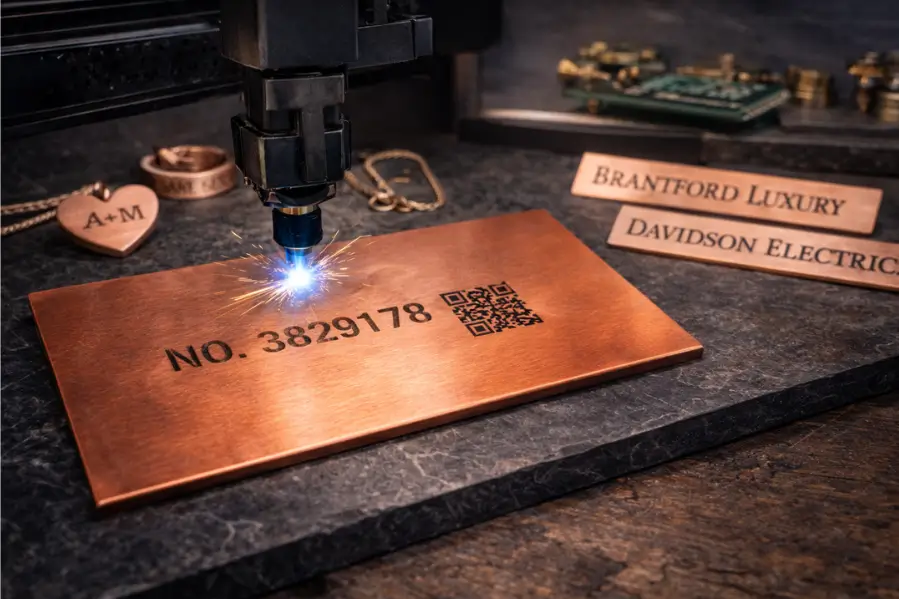

Copper has become a highly sought-after material for custom engraving, luxury branding, electronics, jewelry, industrial components, and premium home décor. As laser engraving technology advances, one question keeps coming up: Can you laser engrave copper?
The answer is yes, but only with the right laser technology and proper technique.
Copper is visually stunning, but it is also one of the most challenging metals to engrave. Its extreme reflectivity and high thermal conductivity make it harder to work with than stainless steel, brass, or aluminum. However, with modern fiber lasers, MOPA technology, and optimized settings, laser engraving copper is not only possible but can produce clean, permanent, and professional results.
This guide explains how laser engraving works on copper, which machines are required, recommended settings, common challenges, real-world applications, and expert tips for achieving consistent results.
Key Takeaways
- Copper can be laser engraved, but it is more challenging than most metals
- MOPA fiber lasers are the best option for precision and color marking
- Standard fiber lasers work well for deep and industrial engraving
- CO₂ lasers require ceramic marking sprays and cannot engrave bare copper
- Proper preparation, testing, and airflow are essential for clean results
- Copper engraving is highly profitable for jewelry, branding, décor, and industrial parts
Why Is Copper Difficult to Laser Engrave?
Copper reflects a large portion of laser energy and transfers heat extremely fast. These two properties create major engraving challenges:
- The laser beam reflects instead of being absorbed
- Heat spreads rapidly, reducing engraving depth
Copper reflects up to 95 percent of laser energy at the common 1064 nm wavelength used by fiber lasers. This means standard settings often fail unless power, pulse, and speed are carefully adjusted.
This behavior is very different from softer or organic materials such as cardboard, which absorb laser energy easily but risk burning if settings are too aggressive.
What Type of Laser Do You Need to Engrave Copper?
Engraving copper requires professional laser technology. The correct laser depends on whether you want surface marking, deep engraving, or color marking.
Best laser types for copper
| Laser Type | Can Engrave Copper | Best For | Notes |
|---|---|---|---|
| MOPA Fiber Laser | Yes (best option) | Color marking, fine detail | Adjustable pulse width improves absorption |
| Standard Fiber Laser | Yes | Deep engraving, serial marking | Needs higher power (30W–50W+) |
| UV Laser | Yes | Micro-marking, electronics | Short wavelength absorbs better |
| CO₂ Laser | No (directly) | Only with marking spray | Cannot engrave bare copper |
For most users, MOPA fiber lasers offer the best balance of control, contrast, and flexibility.
Can You Engrave Copper With a CO₂ Laser?
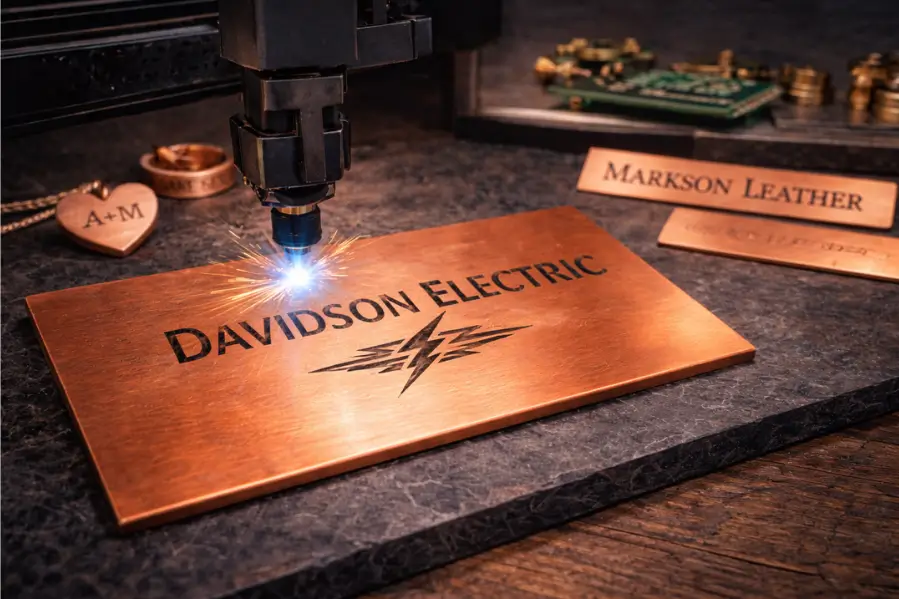
A CO₂ laser cannot engrave bare copper because copper does not absorb the 10.6 µm wavelength. However, CO₂ lasers can mark copper using ceramic marking sprays.
Common marking sprays include:
- Cermark
- Thermark
- LaserBond
These sprays bond to the surface when heated, creating a dark, permanent mark. This method is ideal for labels, barcodes, and logos, but it is not true engraving.
What Can You Create by Laser Engraving Copper?
Copper is widely used in both artistic and industrial applications.
Popular copper engraving uses include:
- Jewelry such as pendants, bracelets, and rings
- Industrial tags and electrical components
- Nameplates and serial labels
- Luxury branding plates
- Custom home décor
- Circuit boards and micro-electronics
- Personalized gifts and ornaments
- Heat sinks and technical parts
Copper’s warm tone and premium look make engraved designs stand out.
For gift-based businesses, copper is often paired with premium materials like leather to increase perceived value and margins.
Benefits of Laser Engraving Copper
Laser engraving offers major advantages over mechanical or chemical methods.
Key benefits
- Extremely high precision for fine details and QR codes
- Permanent markings that do not fade or peel
- Non-contact process that prevents deformation
- Fast production for both small businesses and factories
- Strong contrast, especially with oxidation or color marking
Modern fiber lasers outperform manual engraving in speed, consistency, and repeatability.
Challenges of Laser Engraving Copper
Copper is harder to engrave than most metals. Common challenges include:
- High reflectivity requiring stronger laser output
- Shallow engraving without correct pulse settings
- Burn marks or discoloration if power is too high
- Multiple passes needed for depth
- Inconsistent results on polished surfaces
These challenges are best addressed with MOPA fiber lasers or surface treatments to increase absorption.
Recommended Laser Settings for Engraving Copper
Exact settings depend on machine wattage, copper thickness, and engraving depth. These are reliable starting points.
Fiber laser settings for copper
| Wattage | Speed (mm/s) | Power (%) | Frequency (kHz) | Notes |
|---|---|---|---|---|
| 30W | 300–600 | 70–90 | 100–200 | Light engraving |
| 50W | 400–800 | 50–70 | 80–150 | Deeper engraving |
| 60W+ | 500–900 | 40–60 | 60–120 | Industrial speed |
MOPA fiber color marking settings
| Color | Pulse Width (ns) | Frequency (kHz) | Speed | Notes |
|---|---|---|---|---|
| Black | 150–220 | 200–300 | Medium | Strong contrast |
| Blue | 80–120 | 200–250 | Slow | Requires testing |
| Gold | 100–140 | 200–300 | Fast | Oxidation-based |
| Rainbow | 50–200 | 150–300 | Multiple passes | Advanced use |
Always test first. Copper purity affects results.
How to Laser Engrave Copper Step by Step
- Clean the copper using isopropyl alcohol
- Prepare high-contrast vector artwork
- Choose moderate starting settings
- Apply marking spray if using CO₂ or polished copper
- Run test engravings
- Engrave the final design with airflow enabled
- Clean residue with alcohol and microfiber cloth
Copper vs Other Metals for Laser Engraving
| Metal | Engravability | Difficulty | Best Laser | Notes |
|---|---|---|---|---|
| Copper | Medium | High | MOPA / Fiber | Highly reflective |
| Brass | High | Medium | Fiber | Cleaner than copper |
| Stainless Steel | Excellent | Low | Fiber / CO₂ spray | High contrast |
| Aluminum | Very good | Low–Medium | Fiber / UV | Fast engraving |
| Titanium | Excellent | Medium | MOPA | Ideal for color marking |
Copper is harder than most metals, but results are visually superior when done correctly.
Best Business Uses for Engraving Copper
High-demand applications include:
- Luxury branding plates
- Personalized jewelry
- Electrical and engineering components
- Custom home décor and wall art
- Barware and kitchen accessories
Copper engraving commands premium pricing due to its appearance and durability.
Safety Considerations When Engraving Copper
- Use laser safety goggles rated for your wavelength
- Ensure proper ventilation, especially with coatings
- Avoid unknown plated or coated copper
- Never engrave PVC-coated copper (toxic gas risk)
If you’re unsure about laser safety in general, review this complete guide before starting production. Are laser engravers dangerous?
Elevate Your Copper Engraving Projects
Laser engraving copper requires precision, control, and the right equipment. With professional-grade fiber or MOPA lasers, proper settings, and testing, copper becomes a powerful material for both creative and industrial applications.
Explore professional laser solutions designed specifically for metal engraving to achieve consistent, high-quality copper results.
Frequently Asked Questions
Can you laser engrave raw copper?
Yes, but you need a fiber laser or an MOPA laser for the best results. CO₂ lasers require marking spray.
Why is copper hard to engrave?
Because it is highly reflective and conducts heat quickly, making it harder for lasers to alter the surface.
Can a CO₂ laser engrave copper?
Not directly. You must use a marking spray like Cermark.
Does engraving damage copper?
Laser engraving removes only a minimal layer of the surface and does not structurally damage the metal.
Is laser engraving copper profitable?
Very. Engraved copper jewellery, branding plates, custom décor, and industrial tags have high demand and strong margins.