
Rubber has long been used for stamps, seals, gaskets, and custom industrial parts. But in today’s fast-paced maker economy, where customization, branding, and small-batch production dominate, people want quick, precise, and affordable ways to work with rubber. Laser engraving has become a go-to solution.
So, can you laser engrave rubber? The short answer is yes, and with the right machine, settings, and safety precautions, you can create professional-grade products ranging from rubber stamps to decorative crafts. This guide explains how it works, which types of rubber are best, and what you need to know before getting started.
Key Takeaways
- CO₂ lasers work best for engraving rubber, while fiber lasers are ineffective.
- Not all rubber is safe to engrave. Laser rubber and silicone rubber are ideal, but PVC-based rubber should be avoided.
- Good ventilation is essential to remove strong fumes and protect your machine.
- Popular applications include stamps, seals, gaskets, packaging, crafts, and education.
- Correct settings matter. Power, speed, and resolution determine the quality of results.
- AI and automation are making rubber engraving faster, safer, and more precise.
Can You Laser Engrave Rubber?
Yes, you can laser engrave rubber using CO₂ laser machines, which operate at a wavelength (around 10.6 µm) that interacts effectively with organic, non-metallic materials like rubber.
- CO₂ lasers cut and engrave rubber by vaporizing material in precise patterns.
- Fiber lasers are not suitable for rubber because their wavelength is designed for metals and plastics.
Best practice: Choose “laser rubber” (also called stamp rubber), which is specifically formulated to handle laser processing without releasing toxic fumes.
How Does Laser Engraving Rubber Work?

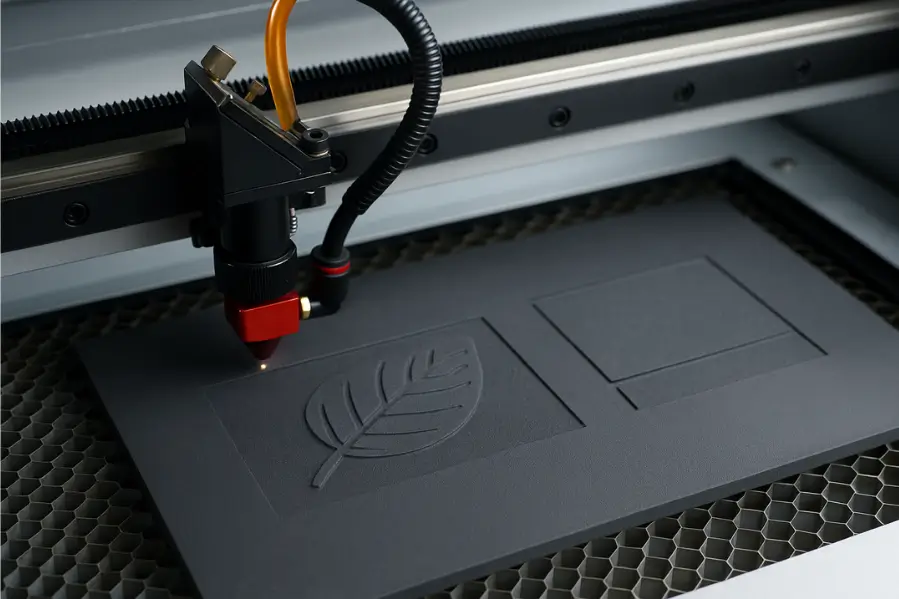
Laser engraving works by focusing a beam of light on the rubber surface, which heats and vaporizes the material along the design path.
The Process Step by Step
- Design setup: Import your logo, text, or pattern into software like LightBurn, RDWorks, or CorelDRAW.
- Laser operation: The CO₂ laser traces the design at set power and speed levels.
- Material removal: The beam vaporizes the top rubber layer, creating depth and texture.
- Cooling and cleaning: Fumes are vented, and engraved areas are brushed or washed to remove residue.
What Types of Rubber Can Be Laser Engraved?
Not all rubber materials are safe or effective for engraving.
| Rubber Type | Suitable for Engraving? | Notes |
|---|---|---|
| Laser Rubber / Stamp Rubber | Yes | Designed for CO₂ lasers, safe fumes, sharp results |
| Natural Rubber | Sometimes | Engraves but may produce strong odors, rougher edges |
| Synthetic Rubber (EPDM, Nitrile, etc.) | Limited | Some engrave well, others release harmful gases |
| PVC-based Rubber | No | Contains chlorine, produces toxic and corrosive fumes |
| Silicone Rubber | Yes | Works well but requires proper ventilation due to smoke |
Always check the Material Safety Data Sheet (MSDS) before engraving.
What Are the Benefits of Laser Engraving Rubber?
Laser engraving rubber has several advantages over traditional cutting or chemical etching.
- Precision: Engrave small fonts, fine logos, and intricate details.
- Consistency: Each piece looks identical, even in large batches.
- Speed: Faster than manual methods like blade cutting.
- Durability: Laser-engraved designs resist fading and wear.
- Customization: Easy to personalize stamps, seals, or craft products.
For comparison with other materials, check out our guides on laser engraving plastic and leather laser engraving ideas. For soft elastomers specifically, see how results differ on silicone rubber.
What Are the Downsides or Risks?
Despite its benefits, laser engraving rubber has some limitations.
- Fumes: Burning rubber produces strong odors and potentially harmful smoke. Proper exhaust or an air filter is a must.
- Mess: The process creates dust and residue that require cleanup.
- Material limits: Cheap rubber with fillers may char, melt, or give uneven results.
- Machine wear: Rubber fumes can damage optics if not ventilated properly.
What Are the Most Common Applications?
Rubber Stamps
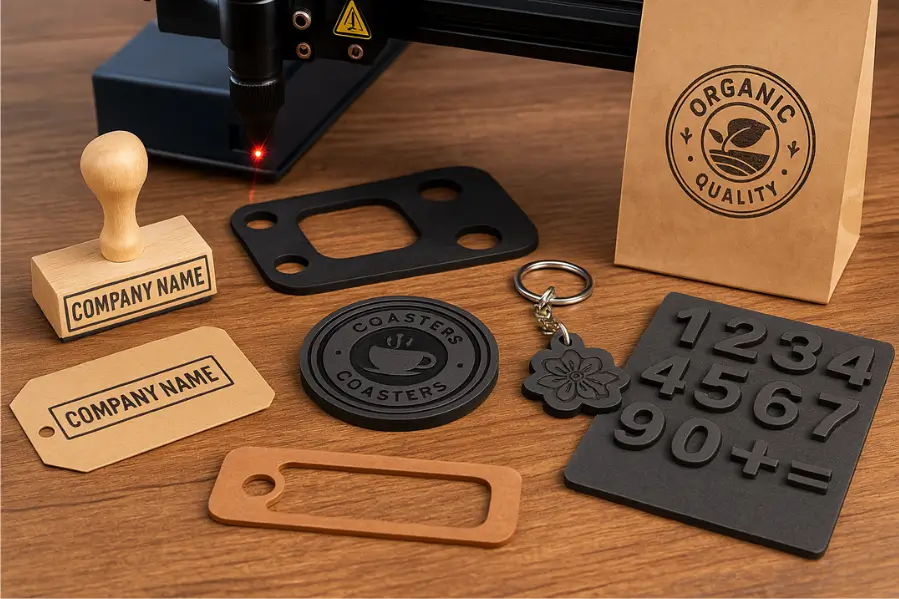
Rubber stamps are the most common application of laser engraving. This process creates deep and precise impressions that transfer ink cleanly, making it ideal for business logos, addresses, dates, and even custom craft designs.
Industrial Seals and Gaskets
Industrial seals and gaskets are frequently produced with laser-engraved rubber. The technology enables precise cutting of gasket shapes and allows manufacturers to add identifiers such as part numbers or instructions directly onto the surface.
Branding and Packaging
Branding and packaging often rely on engraved rubber stamps as an affordable and eco-friendly solution. Companies use them to imprint logos and artwork on kraft bags, boxes, or other packaging materials, avoiding the cost of full-scale custom printing.
Arts and Crafts
Arts and crafts projects benefit from the flexibility of laser-engraved rubber. Makers can design unique coasters, keychains, or decorative inlays that are both functional and visually appealing, giving handmade items a professional touch.
Educational and Hobby Projects
Educational and hobby projects also make use of engraved rubber sheets. Teachers and students can create tactile learning tools, while hobbyists experiment with custom shapes and designs for personal projects. This versatility makes rubber an accessible material for learning and creativity.
What Are the Best Laser Settings for Engraving Rubber?
Settings vary by machine, but here’s a general starting point for a 40–60W CO₂ laser:
| Setting | Recommended Range | Notes |
|---|---|---|
| Power | 30–60% | Too high causes burning, too low doesn’t cut |
| Speed | 200–400 mm/s | Adjust based on depth and detail |
| Resolution (DPI) | 300–600 DPI | Higher DPI = finer detail but slower job |
| Air Assist | On | Keeps debris off lens, reduces smoke marks |
| Passes | 1–3 | Multiple passes for deeper engraving |
Pro tip: Always test on a scrap piece before running the final job.
Looking for a machine that delivers consistent, detailed results on rubber? Check out Thunder Laser CO₂ engravers, designed for both hobbyists and businesses who need precision and reliability.
How Does Laser Engraving Rubber Compare to Other Materials?
| Material | Engraving Difficulty | Fume Concerns | Common Uses |
|---|---|---|---|
| Rubber | Medium | Strong odor, needs ventilation | Stamps, seals |
| Wood | Easy | Mild smoke | Signs, art |
| Acrylic | Easy | Minimal | Signs, awards |
| Leather | Medium | Odor, burns if too hot | Fashion, crafts |
| Glass | Hard | None | Etching, decor |
Rubber requires more ventilation and cleanup than wood or acrylic but produces durable, functional products.
If you’re exploring different surfaces, our guide on laser engraving resin explains how synthetic materials compare to rubber.
What Safety Precautions Should You Take?
Laser engraving rubber is safe if you follow best practices:
- Use a CO₂ laser with exhaust ventilation or air filtration.
- Avoid PVC-based rubber, which releases chlorine gas.
- Wear safety glasses designed for your laser wavelength.
- Clean residue from engraved rubber to prevent smudging.
- Keep a fire extinguisher nearby, as rubber dust can ignite.
Future of Rubber Laser Engraving: AI and Automation
AI-driven design tools are making rubber engraving easier. For example, AI software can auto-generate stamp layouts from uploaded logos, predictive algorithms can adjust speed and power automatically, and smart exhaust systems with sensors can detect harmful fumes in real time.
As laser technology integrates with AI, rubber engraving will become safer, faster, and more precise.
Real-World Example: Small Business Stamp Production
Many small businesses on Etsy and Shopify use laser engravers to create custom rubber stamps for branding and packaging. These stamps are often used on kraft paper bags, shipping boxes, or handmade cards to give products a professional yet personal touch.
One handmade shop reported that switching to a Thunder Laser CO₂ machine reduced stamp production time by 40 percent compared to manual carving. The improved efficiency allowed them to take on more orders without sacrificing quality.
At the same time, the laser delivered sharper details and more consistent results across batches. This shows how laser engraving rubber is not just practical but also profitable for small-scale entrepreneurs.
Conclusion
Laser engraving rubber is a practical and versatile process that enables the creation of detailed stamps, gaskets, packaging tools, and custom craft items. With the right CO₂ laser, proper ventilation, and correct settings, makers and businesses can achieve consistent and durable results.
From small hobby projects to industrial applications, rubber remains a material that responds well to laser processing when handled safely. As AI and automation continue to advance, the future of rubber engraving promises even greater precision, efficiency, and accessibility.
FAQs About Laser Engraving Rubber
What laser is best for engraving rubber?
A CO₂ laser is the best choice for engraving rubber because its wavelength cuts and vaporizes the material cleanly, producing sharp, detailed results. Fiber lasers are not effective for rubber.
Is it safe to laser cut rubber?
Yes, it is safe to laser cut rubber if you use non-toxic materials like laser rubber or silicone and ensure proper ventilation to remove fumes. Avoid PVC-based rubber, as it releases harmful chlorine gas.
Can silicone rubber be laser cut?
Yes, silicone rubber can be laser cut with a CO₂ laser, producing clean edges and accurate shapes. Good ventilation is needed to handle the smoke generated.
How deep should you engrave rubber stamps?
Rubber stamps should be engraved about 1.5 to 2 millimeters deep for clean ink transfer and long-lasting use.
Does laser engraving rubber smell?
Yes, engraving rubber produces a strong odor and smoke, which is why good ventilation or an exhaust system is necessary.
Is laser engraving rubber profitable?
Yes, it is profitable for small businesses that sell custom stamps, packaging tools, or craft products because of the high demand and low production cost.