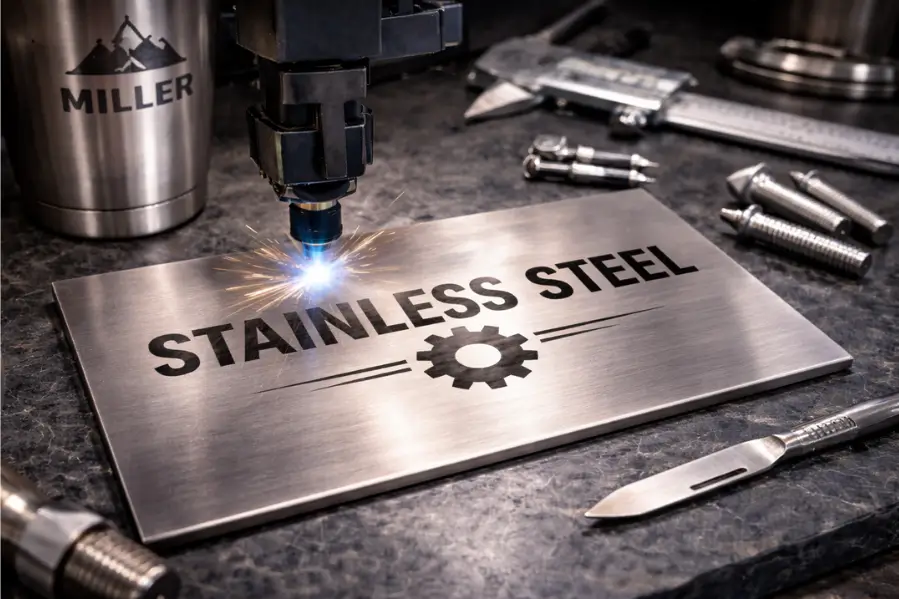

Laser engraving stainless steel has become one of the most in-demand techniques for industrial manufacturing, personalized products, branding, and long-lasting identification. With more companies adopting AI-driven design tools and CAD-to-laser workflows, the question “Can you laser engrave stainless steel?” is more relevant than ever.
Stainless steel is tough, corrosion-resistant, and widely used across engineering, medical, and consumer products. Being able to engrave it cleanly and permanently opens major creative and commercial opportunities.
This guide explains how laser engraving works on stainless steel, which laser types are required, what results to expect, and the advantages and limitations you should understand before starting. It is written to be clear, scannable, and useful for both search engines and real users.
Key Takeaways
- Yes, stainless steel can be laser engraved with permanent, high-contrast results
- Fiber and MOPA fiber lasers are the most effective options
- CO₂ and diode lasers require marking sprays to work on stainless steel
- Laser engraving, etching, and annealing each produce different finishes
- Stainless steel engraving is widely used in automotive, medical, aerospace, and consumer products
- Proper laser settings and safety measures are essential for consistent results
Can You Laser Engrave Stainless Steel?
Yes. Stainless steel can be laser engraved using fiber lasers, MOPA fiber lasers, and CO₂ lasers with marking spray. The process creates a permanent mark that does not fade, peel, or wear off.
Fiber lasers are the most common and effective choice because stainless steel absorbs their wavelength efficiently. This allows for deep engraving, surface etching, or annealing depending on the settings.
If you are comparing stainless steel with other metals, copper behaves very differently under laser energy due to its extreme reflectivity.
Industries such as automotive, aerospace, medical devices, and consumer goods rely on stainless steel laser engraving because it produces precise, durable marks that meet strict regulatory requirements.
How Does Laser Engraving Stainless Steel Work?
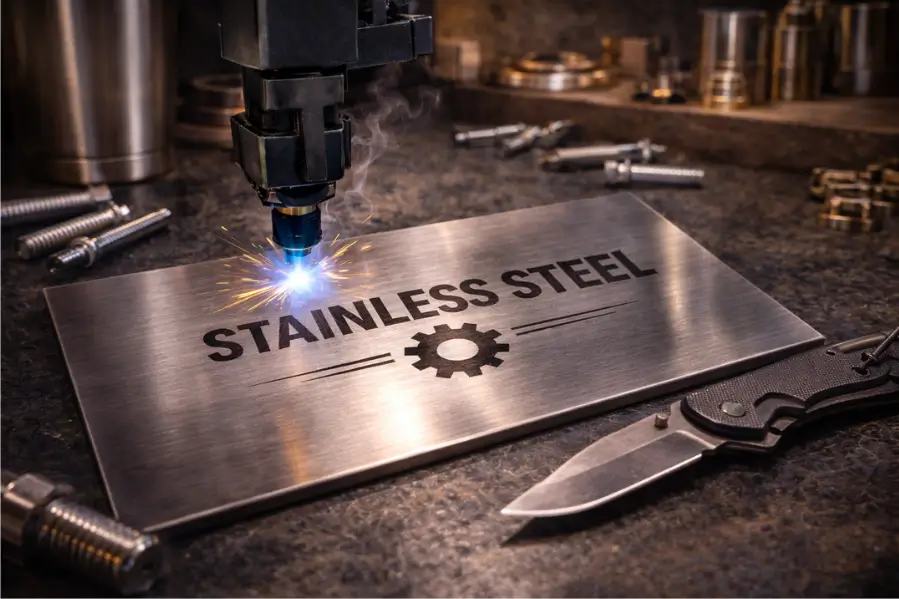
Laser engraving works by directing a concentrated beam of light onto the steel surface. The laser energy heats, melts, or oxidizes the metal depending on the selected process.
Stainless steel reacts in three main ways:
- Engraving – removes material to create deep grooves
- Etching – melts the surface slightly to create shallow marks
- Annealing – heats the metal to create color changes without material removal
Each method is used for different purposes. Serial numbers, barcodes, logos, medical IDs, and decorative designs all require different marking depths and finishes.
This behavior is different from non-metal materials like canvas, where lasers interact with fibers rather than metal oxidation.
What Laser Types Can Engrave Stainless Steel?
Stainless steel is compatible with several laser technologies. Each produces different results and suits different use cases.
| Laser Type | Works on Stainless Steel | Result Quality | Best For | Notes |
|---|---|---|---|---|
| Fiber Laser | Yes | Excellent | Industrial marking, deep engraving | Most efficient and widely used |
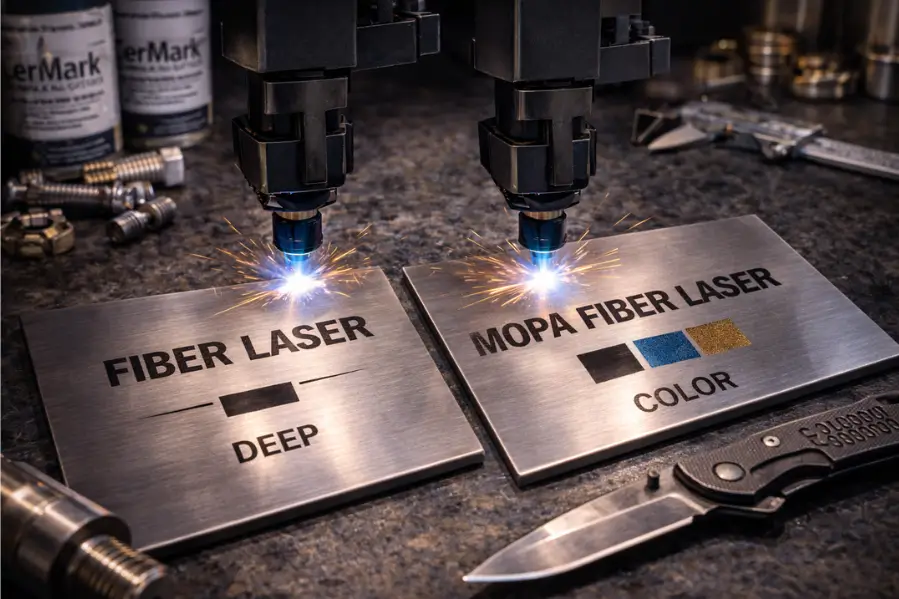
| MOPA Fiber | Yes | Excellent with color control | Color marking, fine detail | Can produce black, blue, gold tones |
| CO₂ Laser | Yes, with spray | Good | Small shops, hobby use | Requires CerMark or similar |
| Diode Laser | Yes, with spray | Moderate | Entry-level use | Not suitable for deep engraving |
For commercial and industrial applications, fiber and MOPA fiber lasers offer the cleanest, most repeatable results.
What Methods Are Used to Engrave Stainless Steel?
Laser Engraving
Material is removed from the surface, creating deep and extremely durable grooves. Best for industrial parts and harsh environments.
Laser Etching
Creates shallow marks by melting the surface. Faster than engraving and ideal for barcodes, QR codes, and branding.
Laser Annealing
Heats the steel to form an oxide layer, producing black or colored marks without removing material. Common in medical and food-grade applications because the surface remains smooth and hygienic.
Benefits of Laser Engraving Stainless Steel
Laser engraving stainless steel offers several advantages over traditional marking methods:
- Long-term durability against corrosion, heat, and chemicals
- Extremely high precision, including micro text and fine graphics
- Works on a wide range of products and industries
- No inks, chemicals, or consumables required
- Seamless compatibility with AI-generated and vector-based designs
These benefits make laser engraving one of the most reliable marking solutions available today.
Downsides of Laser Engraving Stainless Steel
Despite its strengths, there are some limitations:
- Fiber and MOPA laser systems have higher upfront costs
- CO₂ and diode lasers require marking sprays
- Reflective surfaces require safety precautions
- Different stainless steel grades engrave differently
- Highly polished finishes may need pre-treatment
Grades 304 and 316 stainless steel engrave most consistently.
What Items Can You Laser Engrave on Stainless Steel?
Laser engraving works on nearly all stainless steel products, including:
- Cookware and kitchen tools
- Tumblers and water bottles
- Jewelry and accessories
- Medical and surgical instruments
- Machine parts and steel plates
- Nameplates and signage
- Promotional products and gifts
- Tools, knives, and multi-tools
- Firearms and tactical equipment
Do You Need Marking Spray to Engrave Stainless Steel?
Not always.
- Fiber and MOPA lasers do not require marking sprays
- CO₂ and diode lasers require sprays such as CerMark or LaserBond
Marking sprays bond to the metal surface when heated and produce dark, high-contrast marks. They are useful for hobbyists and small shops without fiber lasers.
What Settings Work Best for Laser Engraving Stainless Steel?
Settings vary by machine and application, but general guidelines include:
- Higher power for deep engraving
- Slower speeds for depth
- Adjustable frequency for color effects (MOPA lasers)
- Multiple passes for industrial markings
- Precise focus, especially for annealing
Always follow manufacturer-recommended settings and test before production.
Laser Engraving vs Annealing Stainless Steel
| Feature | Engraving | Annealing |
|---|---|---|
| Material Removal | Yes | No |
| Durability | Very high | High |
| Appearance | Deep grooves | Smooth black or colored mark |
| Best For | Industrial parts, tools | Medical and decorative items |
| Speed | Slower | Moderate |
If depth and permanence are critical, engraving is best. For smooth, sanitary surfaces, annealing is preferred.
Common Objections About Engraving Stainless Steel
Some users worry stainless steel is too hard to engrave or that heat will cause warping. In practice, modern lasers are designed to handle reflective metals safely and efficiently.
Fiber lasers operate at wavelengths absorbed well by steel, making warping rare when proper settings are used. Safety concerns are valid, but proper enclosures, eyewear, and ventilation address these risks.
Start Your Stainless Steel Engraving Journey
Laser engraving stainless steel offers unmatched durability, precision, and professional results. With the right fiber or MOPA laser, stainless steel becomes one of the most versatile and profitable materials for engraving businesses and manufacturers.
If you want consistent results on stainless steel, aluminum, copper, and other metals, explore Thunder Laser USA’s professional metal engraving machines. Their fiber and MOPA systems are built for precision, safety, and scalable production.
FAQs
Can stainless steel be engraved with a CO₂ laser?
Yes, but you need marking spray for high-contrast results. CO₂ lasers do not engrave the metal directly.
Is fiber laser engraving permanent on stainless steel?
Yes. Fiber lasers create marks that are resistant to corrosion, chemicals, heat, and abrasion.
Can you get color engraving on stainless steel?
Yes, MOPA fiber lasers can create color effects like black, gold, blue, and bronze through controlled oxidation.
Which stainless steel grade engraves best?
304 and 316 stainless steel are the most commonly engraved because they react well to laser marking and offer consistent results.
Does laser engraving weaken stainless steel?
No. Engraving depth is shallow relative to the metal thickness and does not reduce structural integrity.