
Rust costs U.S. industry an estimated $276 billion every year, and traditional removal methods — sandblasting, grinding, chemical baths — are slow, abrasive, and dangerous to both workers and the metal underneath. Laser rust removal flips the equation. It’s a non-contact, chemical-free, dry process that vaporizes oxide layers in seconds while leaving the substrate untouched.
If you’ve searched for laser rust removal, you’ve probably seen surface-level articles that don’t actually help you decide what to buy or whether the technology fits your shop. This guide goes deeper. We’ll cover the physics in plain English, walk through every laser type used for rust removal, compare laser cleaning to every traditional method honestly, break down real-world costs, and help you match a machine to your actual application — whether you’re a hobbyist cleaning small parts or running an industrial restoration line.
Quick Answer: What Is Laser Rust Removal?
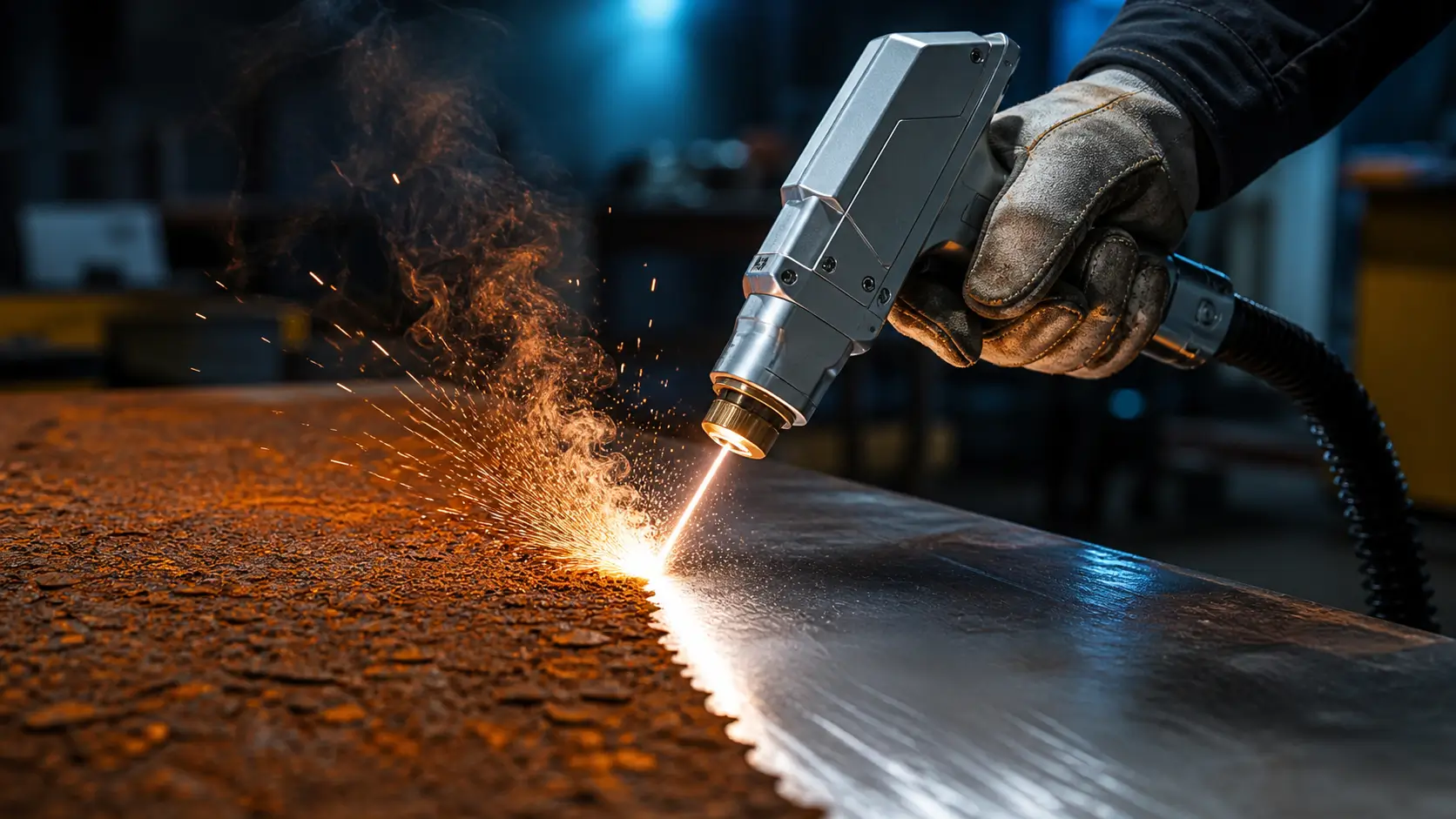
Laser rust removal (also called laser cleaning or laser ablation) is a process that uses focused laser beams to vaporize rust, paint, oil, and other contaminants from metal surfaces without physically touching them. The laser energy heats the contaminant past its ablation threshold — the energy level at which it breaks down — while the underlying metal, which has a much higher threshold, remains undamaged. The result: a clean, bare-metal surface ready for welding, painting, or coating, produced with no chemicals, no abrasive media, and no risk of dimensional damage to the part.
How Does Laser Rust Removal Actually Work?
The science is called laser ablation, and it relies on a property every material has: an ablation threshold. This is the energy density (measured in joules per square centimeter) at which the bonds holding the material together break down and the material vaporizes or sublimates.
Here’s what happens, step by step:
- The laser source generates a beam at a specific wavelength — typically 1064 nanometers for fiber and infrared lasers used on metal. This wavelength is absorbed efficiently by iron oxides (rust) but reflected by clean metal.
- The beam is focused through a galvo head, lens, or scanner onto the rusted surface in pulses or a continuous wave.
- Energy density on the rust exceeds its ablation threshold (rust ablates at roughly 0.5 J/cm², depending on composition).
- Energy density on the underlying metal stays below its threshold (steel, for example, needs around 2–10 J/cm² to ablate).
- The rust vaporizes into plasma and dust, gets pulled away by the fume extractor, and the bare metal underneath is revealed — chemically and dimensionally unchanged.
This selectivity is what makes the process so powerful. You’re not grinding, you’re not dissolving, you’re not blasting. You’re picking the rust off the metal at a molecular level using a precisely tuned beam of light.
The same principle works for paint, oil, grease, mill scale, oxide layers, and even some adhesives. Each contaminant has its own threshold, so by tuning power, pulse duration, and scan speed, an operator can remove a specific layer while preserving everything below it.
Types of Lasers Used for Rust Removal
Not every laser can remove rust well. The wavelength has to match what the rust absorbs, and the power and pulse characteristics determine how fast and how cleanly the job goes. Three categories matter.
Fiber Lasers (The Industrial Standard)
Fiber lasers are the dominant technology for serious rust removal work. They generate the beam inside a doped optical fiber, which delivers extremely high beam quality, excellent power efficiency, and a wavelength (1064 nm) that metals readily absorb.
- Power range: 1,000W to 3,000W is standard for cleaning applications, though specialized systems push past 6,000W for shipyard and bridge work.
- Cleaning rate: Light surface rust at up to 50 cm² per second. Heavy corrosion at around 5 cm² per second.
- Cost: $6,000 for entry-level 1000W handhelds, $9,000–$18,000 for 1500W–3000W professional systems, and $30,000+ for fully automated industrial cells.
- Best for: Automotive restoration shops, fabrication plants, weld preparation, pre-coating treatment, mold cleaning, and any application where speed and durability matter more than upfront cost.
Within fiber lasers, you’ll see two beam delivery types:
- Continuous Wave (CW): Constant beam output. More aggressive, faster on large or heavily corroded areas, less precise on delicate surfaces. Standard for 1500W+ industrial cleaners.
- Pulsed Fiber: Short, high-peak-power bursts (typically 100–500W average power, but megawatt-level peak power per pulse). Gentler, more precise, better for thin sheet metal, polished surfaces, molds, and historical artifacts where damage tolerance is near zero.
Pulsed Infrared Lasers (For Small-Scale Work)
Infrared lasers also operate around 1064 nm but deliver power in different ways. Compact, lower-wattage infrared modules (typically 2W–20W) are built into desktop machines designed primarily for metal marking and engraving, but they can handle small-scale rust removal as a secondary function.
- Power range: 2W–100W for compact and benchtop systems.
- Cleaning rate: Suitable for small parts, tools, jewelry, firearm components, and post-weld touch-ups — not bridges or car panels.
- Cost: $1,500 to $10,000 depending on enclosure, work area, and accessories.
- Best for: Hobbyists, jewelers, restoration craftspeople, makers, small custom shops, and anyone who already needs metal marking capability and wants rust removal as a bonus feature.
This is the tier where Thunder Laser’s Aurora series fits — more on that below.
CO2 Lasers (Generally Not Suitable)
CO2 lasers operate at 10,600 nm — about ten times the wavelength of fiber and infrared lasers. At this wavelength, bare metal reflects most of the energy, and the absorption profile of iron oxide isn’t well-matched either. CO2 lasers are excellent for wood, acrylic, leather, fabric, and coated metals, but for rust removal on bare steel they’re inefficient and largely impractical. If a vendor tells you a CO2 machine will handle your rust removal needs, that’s a red flag.
Comparison Table: Laser Types for Rust Removal
| Feature | Pulsed Infrared | Pulsed Fiber (Pro) | CW Fiber (Industrial) | CO2 |
| Wavelength | 1064 nm | 1064 nm | 1064 nm | 10,600 nm |
| Typical Power | 2–100W | 100–500W | 1,000–3,000W+ | 40–150W |
| Cleaning Speed | Slow (small parts) | Medium | Fast (50 cm²/sec) | Not effective |
| Substrate Safety | Excellent | Excellent | Good (calibrated) | N/A |
| Best For | Hobby, jewelry, marking | Molds, precision parts | Automotive, weld prep | Not recommended |
| Price Range | $1,500–$10,000 | $8,000–$25,000 | $6,000–$18,000 | N/A for rust |
| Portability | Tabletop | Cart or handheld | Rolling cabinet | Bench |
Laser Rust Removal vs. Traditional Methods
Most articles list benefits without honest comparison. Here’s how laser actually stacks up against the alternatives, including the cases where traditional methods still win.
Laser vs. Sandblasting and Shot Blasting
Sandblasting wins on: Large surface area cleaning at low cost, rough texture profiles needed for some coatings, very heavy scale on structural steel.
Laser wins on: Precision (no over-blasting), substrate preservation (no metal removal, no warping of thin sheet), no media containment requirements, no abrasive cleanup, dimensional control on tolerance-critical parts. Laser also avoids the dust containment, PPE, and OSHA respiratory compliance burdens that come with abrasive blasting.
Verdict: Blasting for civil engineering and rough industrial. Laser for anything that needs to come out clean, accurate, and ready for the next process.
Laser vs. Chemical Rust Removal
Chemicals win on: Reaching internal cavities and threaded holes that line-of-sight lasers can’t access, very low equipment cost for occasional use.
Laser wins on: Worker safety (no acid handling), zero hazardous waste, no neutralization or rinse step, no dimensional etching of the substrate, no flash rust risk, no environmental disposal liability. Phosphoric, hydrochloric, and sulfuric acids — the typical rust strippers — are dangerous to handle, expensive to dispose of legally, and slowly damage the metal even at correct dilution.
Verdict: Chemicals are increasingly indefensible from a safety, compliance, and cost-of-disposal standpoint. Laser is the modern replacement for nearly all chemical rust stripping.
Laser vs. Manual Grinding and Wire Wheels
Manual wins on: Lowest possible upfront cost, no electricity beyond the grinder.
Laser wins on: Speed (10–50x faster on equivalent areas), consistency, no operator fatigue, no metal removal, no heat-affected zones, no abrasive grit embedded in the substrate (a real problem when you grind stainless steel with a regular wheel — it cross-contaminates and causes future rust). Manual grinding also generates particulate that’s harmful to lungs without proper PPE.
Verdict: Grinding is fine for one-off shop tasks. For any volume work or anything that gets welded or coated afterward, laser pays for itself fast.
Laser vs. Dry Ice Blasting
Dry ice wins on: Cleaning electrical equipment in place, food-grade applications, completely residue-free finish.
Laser wins on: Speed, precision on small features, no CO2 emissions, no consumable cost (dry ice pellets run roughly $1–$2/lb and a job can use hundreds of pounds), and far better handling of heavy rust where dry ice struggles.
Verdict: Dry ice for in-place electrical and food applications. Laser for almost everything else.
Real-World Applications of Laser Rust Removal
The technology shows up everywhere precision and substrate preservation matter:
Automotive restoration. Removing rust from classic car body panels, frames, and underbody components without warping the thin sheet metal that sandblasting routinely destroys. Brake disc cleaning before passivation. Drivetrain refurbishment instead of replacement.
Aerospace. Cleaning ingots, turbine components, and structural parts where the base metal is sold by weight and any abrasive removal is literally throwing money away. Quality validation cleaning before NDT inspection.
Welding preparation. Pre-weld surface cleaning to eliminate the porosity, cracking, and weld-strength loss that contamination causes. Post-weld cleaning to remove scale, discoloration, and oxide before painting or coating — this is one of the highest-volume use cases for laser cleaning industrially.
Mold and tooling maintenance. Rubber, plastic, and tire molds accumulate residue between runs that traditionally required removal from the press for solvent cleaning. Pulsed fiber lasers clean molds in place without damaging the polished cavity surfaces.
Marine and shipyard. Hull cleaning, rust removal from fittings, deck preparation. The volume work is still abrasive blasting, but laser handles the precision and no-warp requirements.
Cultural heritage and restoration. Cleaning historical artifacts, bronze statues, antique firearms, and architectural features where any abrasive contact would be unacceptable. Pulsed fiber lasers tuned to extremely low power can clean centuries of patina from surfaces that no other method could safely touch.
Manufacturing automation. Pre-coating preparation, surface texturing for adhesive bonding, oxide removal on electrical contacts and connectors.
Small parts and DIY. Tools, knives, firearms, jewelry, hardware, antique restoration projects, motorcycle parts, model trains, and the long tail of small-scale work where a compact infrared laser does the job at a fraction of industrial cost.
How Much Does a Laser Rust Removal Machine Cost?
Pricing splits into clear tiers, and matching the tier to your actual workload is the single most important purchase decision you’ll make.
| Tier | Power | Price Range | Realistic Use Case |
| Compact desktop (infrared) | 2W–20W | $1,500–$5,000 | Hobby, jewelry, small parts, marking + light cleaning |
| Benchtop fiber marker | 20W–100W | $5,000–$15,000 | Custom shops, jewelers, post-engraving cleanup, small restoration |
| Handheld pulsed fiber | 100W–500W | $8,000–$20,000 | Mold cleaning, precision restoration, delicate substrates |
| Handheld CW fiber | 1,000W–2,000W | $6,000–$12,000 | Auto body, weld prep, general industrial |
| Industrial CW fiber | 2,000W–3,000W | $12,000–$18,000 | Heavy industrial, shipyard, large fabrication |
| Automated cells | Custom | $30,000–$200,000+ | High-volume manufacturing, robotic integration |
Beyond the laser itself, budget for:
- Fume extraction ($800–$3,000): mandatory for any indoor use, removes vaporized oxide and paint particulate.
- Laser safety glasses ($50–$300 each): rated for 1064 nm.
- Class 1 enclosure or workshop laser-safe room: required for pulsed and high-power operations under most regulatory frameworks.
- Training and operator certification: $500–$2,000 if not bundled with the machine.
- Replacement protective lenses: $30–$100 each, consumable on handheld guns.
How to Choose the Right Laser Rust Removal Machine
There’s no universal “best” machine — only the best one for your specific workload. Walk through these questions in order.
1. What’s the largest part you’ll clean, and what’s your typical part? If most work is under 6 inches (jewelry, tools, gun parts, small castings), a desktop or benchtop fiber laser is overkill if you go bigger. If most work is car panels, gates, or industrial parts, you need a handheld system, full stop.
2. What’s the rust load — light surface oxide or heavy scale? Light surface rust runs efficiently on lower-power systems. Heavy scale and deep pitting need 1500W+ CW fiber to be productive. Trying to clean a rust-pitted axle housing with a 50W marker will work — but it’ll take an entire afternoon for one part.
3. How sensitive is the substrate? Thin sheet metal, polished surfaces, plated parts, and softer alloys benefit from pulsed delivery. CW fiber at high power can heat-distort thin steel if the operator doesn’t manage scan speed carefully. Pulsed is more forgiving for varied work.
4. Do you need rust removal alone, or rust removal plus other capabilities? If you also need metal marking, engraving, or precision finishing, an integrated fiber laser system gives you both for one purchase. If you only ever clean rust at industrial volume, a dedicated handheld cleaner is more cost-efficient per square inch cleaned.
5. What’s your duty cycle? Hobby and occasional use: any tier works. 4+ hours per day production: invest in industrial-grade construction, water cooling, and proper duty-cycle ratings. Continuous 8+ hour shifts: automated or semi-automated cells pay for themselves in 12–24 months on labor savings alone.
6. Indoor or in-field? Handheld fiber cleaners with 33-foot fiber cables are standard for in-field work. Desktop and benchtop systems are workshop-only.
Where Thunder Laser Fits: Aurora for Small-Scale Cleaning and Post-Processing
Thunder Laser is best known for its CO2 cutting machines (the Nova and Bolt series), but their Aurora fiber laser line is genuinely useful for the small-scale, precision rust removal segment — especially as a multi-purpose machine that does marking, engraving, AND light cleaning rather than a single-purpose cleaner.
The Aurora series uses 1064 nm fiber laser sources with galvo scanning heads, which is the same wavelength and beam-delivery technology as professional fiber cleaners. Where the Aurora differs is power class and form factor: it’s an enclosed, desktop-class fiber laser optimized for marking, with cleaning capability as a useful secondary function.
Where Aurora makes sense for rust removal:
- Post-weld cleanup on small parts. Cleaning oxidation around weld seams on jewelry, tools, knives, and small fabricated components before final finishing.
- Pre-coating prep for small metal goods. Removing light surface oxide before powder coating or painting tumblers, tags, custom hardware, and similar product-line goods.
- Restoration of small antique items. Tools, instruments, watch parts, model components, firearm small parts, hardware.
- Custom shops that already need metal marking. If you’re a custom shop running engraved metal products, the Aurora handles both the marking and the light cleaning between processes — one machine, two functions, no separate cleaner needed.
- Mold and die cleaning at hobbyist or jewelry scale. Pulsed fiber operation is gentle enough for delicate cavity cleaning.
Where Aurora isn’t the right tool:
- Heavy rust removal on automotive body panels, frames, or large fabricated parts. For that workload, you need a 1500W+ handheld CW fiber cleaner from a dedicated cleaning-machine vendor.
- Industrial-scale weld preparation on structural steel.
- Bridge, marine, or shipyard work.
- Field service rust removal on equipment in place.
If your workload is in the small-parts, custom-shop, or maker space, Aurora is a sensible buy that covers marking, engraving, AND light cleaning in one enclosed, training-supported package. If you’re in heavy industry or full-scale restoration, you’ll need a different category of tool — and that’s an honest read of where the technology fits.
You can review the full Aurora lineup and Thunder Laser’s other machines on the Thunder Laser USA machines page.
Is Laser Rust Removal Safe?
Yes, when operated correctly — and significantly safer than the alternatives. The main hazards and how they’re managed:
Laser radiation. 1064 nm is invisible and can permanently damage eyes from direct or reflected exposure. Mitigation: rated laser safety glasses (OD 6+ at 1064 nm), Class 1 enclosures for pulsed systems, posted laser-controlled areas, and operator training. Properly enclosed industrial systems require no operator PPE.
Fumes and particulate. Vaporized rust, paint, and coating residue is hazardous to inhale. Mitigation: HEPA-rated fume extraction at the source — non-negotiable for indoor use.
Reflected beam. Polished metal surfaces can reflect 1064 nm energy unpredictably. Mitigation: enclosed systems, light barriers in the work zone, and operator awareness of part geometry.
Electrical. Standard industrial wiring practices apply.
Compared to acid handling, abrasive blast cleanup, manual grinding particulate, and the chronic injury risk of vibrating tools, laser cleaning is the safest established rust removal method available.
Limitations of Laser Rust Removal (The Honest Version)
Most articles skip this section. Here are the real constraints you should plan around:
- Line-of-sight only. The laser can’t reach what it can’t see. Internal cavities, blind holes, threads, and complex internal geometries still need chemical or alternative methods.
- Slower than blasting on very large flat surfaces. A 3,000W laser cleans roughly 50 cm²/second on light rust. A high-pressure sandblaster covers far more area per second on a barn-sized flat surface. For square footage at scale, blasting is still faster.
- Capital cost. Even entry-level professional systems start around $6,000. Hobby tier infrared starts lower. There’s no $200 laser rust remover that works.
- Operator skill. Anyone can hold a sandblast nozzle. Laser cleaning requires proper power, frequency, scan speed, and overlap settings to avoid either underclean (residual rust) or overclean (substrate damage). Training matters.
- Mixed contaminants. A part with rust, paint, oil, AND adhesive needs a cleaning strategy with multiple parameter sets. Single-setting cleaning rarely works on real-world dirty parts.
- High-mix part variability. If every part is different, automation gets complicated. Manual handheld operation handles variety best.
These aren’t deal-breakers — they’re planning factors. Match the tool to the job.
Frequently Asked Questions
Is laser rust removal worth the cost?
For any shop processing more than a few parts per week, yes. The break-even point versus chemical or sandblasting (factoring labor, consumables, disposal, PPE, and rework from substrate damage) is typically 6–18 months at industrial volumes. For hobbyists doing a few projects a year, the math is harder to justify unless the laser also serves as a marking and engraving machine.
Can a laser remove rust without damaging the metal underneath?
Yes — that’s the entire point of the technology. Rust ablates at a much lower energy threshold than the underlying metal, so a properly tuned laser strips the oxide layer cleanly while leaving the substrate dimensionally and chemically unchanged. You can verify this with calipers before and after — there’s no measurable material loss on a correctly run job.
How fast is laser rust removal compared to sandblasting?
On equivalent surface area, laser is generally slower than sandblasting on large flat surfaces and faster than sandblasting on small or precision parts where masking and post-cleanup time dominate. The real advantage isn’t raw speed — it’s total job time including setup, containment, post-cleaning, and any rework from substrate damage. On those total-job metrics, laser typically wins.
Can laser cleaning remove paint as well as rust?
Yes. Paint, primer, powder coating, anodizing, and most coatings ablate at thresholds within reach of cleaning lasers. The same machine handles all of them with parameter adjustments. This is one of the largest applications of laser cleaning industrially — paint stripping for refurbishment.
Does a CO2 laser remove rust?
Practically, no. CO2’s 10,600 nm wavelength is poorly absorbed by both rust and bare metal. CO2 is the wrong tool for this job. Use fiber or pulsed infrared instead.
Is laser rust removal environmentally friendly?
It’s the most environmentally friendly established method. No chemicals, no water, no hazardous waste streams, no abrasive media to dispose of. The only waste is the vaporized contaminant captured by the fume extractor’s HEPA filter, which is much smaller in volume than blast media or chemical sludge.
Can I use laser rust removal on aluminum, stainless steel, or copper?
Yes, all three. Each has different ablation characteristics and may need pulsed delivery (especially aluminum and copper, which reflect more 1064 nm energy than steel), but laser cleaning is established practice on all common engineering metals including titanium, brass, bronze, and nickel alloys.
What size laser do I need for car restoration?
For body panels, frames, and underbody work, a 1,500W–2,000W handheld continuous wave fiber laser is the practical minimum for productive work. Lower power will technically clean — it’ll just take so long that you’ll wish you’d bought up. For wheels, brake parts, and small components, 100W–500W pulsed fiber is excellent. For hobby restoration of small parts only, a 50W–100W enclosed fiber system handles it.
Do I need a special permit or license to operate a laser rust removal machine?
No license is required for operators in the United States. Class 1 enclosed systems have no special facility requirements. Class 4 open-beam systems (most handhelds) require a designated laser-controlled area, posted warnings, a Laser Safety Officer designation in workplaces under OSHA jurisdiction, and proper PPE. Check ANSI Z136.1 for the U.S. standard. Your local jurisdiction may add requirements — verify before purchase.
How long does a fiber laser cleaning machine last?
A well-maintained fiber laser source typically operates for 80,000 to 100,000 hours before significant power degradation — roughly 10+ years of normal duty cycle. Optical components (protective lenses, focusing lenses) are consumables and need periodic replacement. The laser source itself is the longest-lived component in the system.
The Bottom Line
Laser rust removal isn’t hype — it’s a mature technology that genuinely outperforms traditional methods on precision, substrate safety, environmental impact, and total cost of ownership for any shop running more than occasional rust work. The catch is matching the right tier of machine to the actual workload, and being honest about where alternatives still win (heavy structural blasting, deep cavity cleaning, very low-volume occasional use).
For industrial restoration, fabrication, automotive, and aerospace, a 1,500W–3,000W handheld fiber cleaner from a dedicated cleaning-machine specialist is the right call. For custom shops, jewelers, makers, and small businesses that want metal marking, engraving, AND light cleaning in one enclosed and well-supported package, Thunder Laser’s Aurora fiber series fits the workflow at a price that’s accessible to small operations. If your only work is heavy industrial cleaning at volume, look at dedicated cleaners; if your work is small parts and you want a multi-purpose fiber laser, the Aurora is worth a serious look.
Whatever you choose, two rules apply: don’t buy underpowered for your real workload, and don’t skip fume extraction or proper safety equipment. The technology delivers on its promises when it’s set up correctly.
About this guide: This article reflects current laser cleaning industry practice as of 2026 and pricing observed across major U.S. and international vendors. Specifications and prices are typical — verify with vendors for exact current quotes. This guide is informational; for application-specific advice, consult a laser systems integrator or vendor application engineer.