Which Materials Are Not Suitable for Laser Cutting and Engraving?
The materials that will damage your machine, the ones that need serious extraction, and the ones that are simply the wrong laser. Three different problems that usually get lumped together.

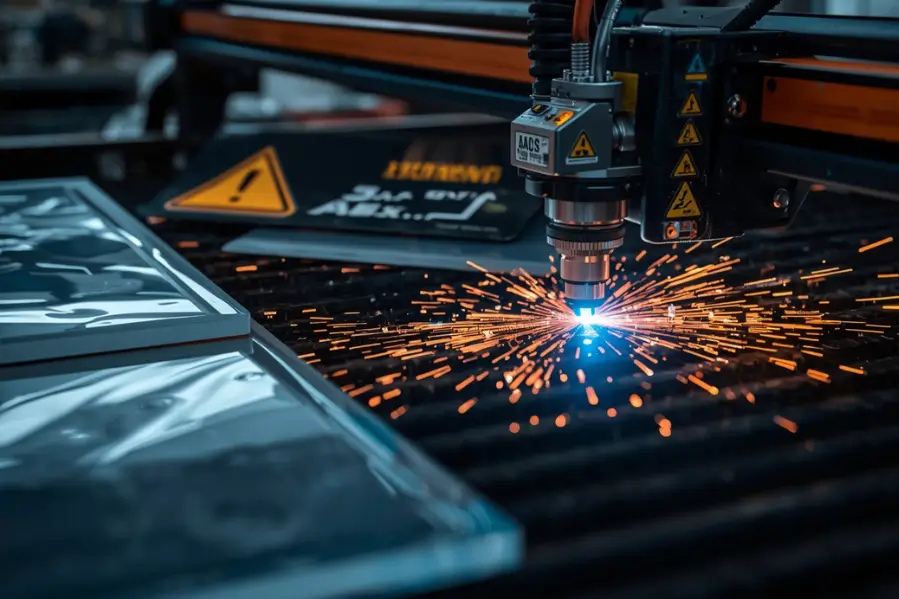
Some materials should never go in a laser under any circumstances. PVC and vinyl release hydrogen chloride that turns to acid inside the machine and corrodes optics, rails and electronics. PTFE, polystyrene foam, galvanised metal and any material with an unknown coating belong in the same category. A second group, including ABS, chrome-tanned leather, MDF, fibreglass and carbon fibre, can be processed but produce genuinely hazardous fumes and demand real extraction. A third group is not dangerous at all, just the wrong tool: bare metal on a CO2 laser and wood or fabric on a fiber laser simply will not work.
Key takeaways
- Not every "no" means the same thing. One material will destroy your machine, another needs extraction, and a third is just the wrong laser type. Treating them as one list is why this topic confuses people.
- PVC is the only absolute. It is roughly 57 percent chlorine. Lasering it forms hydrochloric acid inside the enclosure, and ventilation does not prevent it because deposition happens during the cut.
- ABS releases hydrogen cyanide, not just "unpleasant fumes". The acrylonitrile in ABS decomposes to hydrogen cyanide under laser heat. It is processable with proper extraction, but it is not a minor smell issue.
- Chrome-tanned leather is contested, and ventilation is the variable. Peer-reviewed work measured high hexavalent chromium concentrations during laser cutting when extraction was off. Vegetable-tanned leather is the safer default.
- If you cannot identify it, do not cut it. Check the recycling code, ask for a safety data sheet, and treat unknown coatings as unknown chemistry. A lens costs more than the job.
Most guides to this topic present a single list of banned materials, and that list mixes together three completely different problems. It puts PVC, which will corrode your machine from the inside, in the same category as copper, which is perfectly safe and simply needs a different laser.
This guide separates them, because the right response is different in each case. One group you avoid entirely. One group you can run with proper extraction and an understanding of what you are breathing. One group is just a tooling question with no safety implication at all.
Three Different Kinds of No
Category | What It Means | Your Response |
|---|---|---|
Never process | Damages the machine, the operator, or both. No setting or extraction makes it acceptable | Do not put it in the laser. Use a router, knife or waterjet |
Hazardous but processable | Genuinely harmful fumes or dust, but manageable with proper extraction and care | Run it with real extraction, know what you are dealing with, clean the machine more often |
Wrong tool | Nothing dangerous. The material simply does not absorb that wavelength | Use the other laser type, or a different process entirely |
Almost every argument about whether a material is laser safe comes down to people talking about different categories without saying so.
Never Process These
PVC and Vinyl
This is the one that matters most. PVC is roughly 57 percent chlorine by weight. Under laser heat it decomposes into hydrogen chloride, which combines with ambient moisture to form hydrochloric acid inside the machine. That acid settles on mirrors and the focus lens, etches metalwork, attacks linear rails and bearings, and reaches the electronics. Ventilation does not prevent it, because the deposition happens during the cut, before any exhaust can clear it.
Machines have been written off by a single job. Most manufacturers treat cutting PVC as a warranty-voiding event, and the fumes are a respiratory hazard on top of the equipment damage.
PVC is difficult to spot because it is sold under names that do not mention it. Rigid PVC foam board trades as Sintra, Forex, Komatex, Palight and Celtec. Faux leather and vinyl banner stock are frequently PVC. Anything labelled expanded PVC, closed-cell PVC or foamed vinyl is the same material.
Our guide to laser cut foam covers how to identify PVC foam board before it reaches the bed, and what to do if you have already cut some.
PTFE and Fluoropolymers
PTFE, sold as Teflon, and related fluoropolymers release hydrogen fluoride when heated. Hydrogen fluoride forms hydrofluoric acid on contact with moisture, including the moisture in your lungs and eyes. It also produces perfluoroisobutylene, which is acutely toxic.
This is a short section because there is nothing to weigh up. Do not laser fluoropolymers.
Polystyrene and Styrofoam
Polystyrene has a low melting point and ignites readily. Rather than cutting, it melts back from the kerf, pools, and frequently catches fire. Expanded polystyrene, the white foam used in packaging, is one of the most common causes of laser fires among people experimenting with scrap material.
It also releases styrene, which is a recognised health hazard. Extruded polystyrene sheet used in model making can be run with great care at very low power, but as a general material it belongs in this group.
Galvanised and Zinc-Coated Metal
Galvanised steel has a zinc coating. Heated, zinc vaporises and forms zinc oxide fumes, which cause metal fume fever, an acute flu-like illness familiar to welders. It is rarely permanently harmful but it is genuinely unpleasant and entirely avoidable.
If you need to mark galvanised stock, strip the coating in the mark area first, or accept that you need extraction rated for metal fume rather than ordinary particulate.
Beryllium and Beryllium Alloys
Beryllium copper and similar alloys appear in springs, connectors and some tooling. Beryllium dust and fume cause chronic beryllium disease, an irreversible lung condition, at very low exposure levels. This is industrial-hygiene territory rather than workshop territory. Do not process it without controls designed specifically for beryllium.
Anything With an Unknown Coating
A material can be perfectly laser safe and still be coated with something that is not. Flame retardants, plasticisers, vinyl laminates and some paints all change the chemistry of what comes off the surface.
If you do not know what the coating is, treat the whole piece as unknown. That includes reclaimed timber, salvaged sheet goods, second-hand furniture and anything with a finish you cannot identify.
Hazardous but Processable With Real Extraction
These materials are run commercially every day. They are not in the never category. But each one produces something worth understanding, and each one deserves better than the vague warning about fumes that most guides give.
ABS Plastic
ABS releases hydrogen cyanide. The acrylonitrile in acrylonitrile butadiene styrene decomposes under laser heat into hydrogen cyanide, alongside styrene. Most articles on this subject describe ABS as producing an unpleasant smell, which considerably understates it. ABS is workable with proper extraction, but it should be treated as a chemical exposure question rather than an odour question.
Beyond the fumes, ABS also behaves poorly. It melts and curls rather than cutting cleanly, leaves a sticky residue on the cut edge, and discolours. Acrylic gives far better results if the design allows a substitution.
Note that ABS marks well on a fiber laser, where you are altering the surface rather than burning through the material. That is a different process with a much lower thermal load.
Chrome-Tanned Leather
This one is genuinely contested, and it is worth being straight about the evidence rather than picking a side.
Leather is tanned using trivalent chromium, which is not the hazardous form. The concern is that hexavalent chromium, a recognised carcinogen, can form from trivalent chromium under certain conditions. Some industry sources state that unpublished testing found no hexavalent chromium formed during laser cutting.
However, a peer-reviewed study published in 2024 measured airborne emissions during laser cutting of leathers tanned six different ways, and found high concentrations of hexavalent chromium from chrome-tanned samples specifically when the ventilation system was switched off. The authors describe ventilation as playing a critical role.
The sensible reading is that extraction is the variable that matters. Vegetable-tanned leather is the safer default and engraves better anyway, producing the rich brown contrast leatherworkers want. If you are cutting chrome-tanned leather, running proper extraction is not optional.
Separately, avoid faux and synthetic leather entirely unless you can confirm what it is made of. A great deal of it is PVC.
MDF and Engineered Wood
MDF is one of the most commonly lasered materials in the world, and it contains formaldehyde-based resin binders. Lasering it releases formaldehyde alongside the wood smoke.
This is not a reason to avoid MDF, which cuts and engraves well. It is a reason to run extraction rather than a desk fan, and to be aware that a room full of MDF smoke is not the same as a room full of wood smoke. Low-formaldehyde and E0-rated MDF is available and worth specifying if you cut a lot of it.
The same applies to plywood, which uses adhesives between plies, and to any particle board.
Fibreglass
Fibreglass is glass fibre in a resin matrix, and both halves cause problems. The resin burns and releases fumes, and the glass fibres do not cut cleanly, leaving a ragged edge. Worse, the process releases fine glass particulate that is abrasive to the machine and a respiratory irritant.
Some operators do cut thin fibreglass with heavy extraction. For most workshops it is not worth it, and mechanical cutting gives a better edge anyway.
Carbon Fibre
Carbon fibre composite is similar. The epoxy resin binder burns and produces fumes, and the fibres themselves do not vaporise cleanly at CO2 wavelengths, so cut edges tend to fray and delaminate.
The dust is electrically conductive, which is the detail most people miss. Carbon dust settling inside a machine can cause shorts in the electronics. If you do process carbon fibre, clean the machine thoroughly afterwards rather than letting it accumulate.
Marking carbon fibre on a fiber laser is a different and far more manageable proposition than cutting it on a CO2 machine.
Polycarbonate
Polycarbonate is a poor CO2 cutting material. It absorbs infrared strongly, so instead of a clean cut you get a melted, discoloured edge that yellows badly. Thick sheet is effectively uncuttable to any usable standard.
It is not especially dangerous, and it is worth separating that from the quality problem. Thin polycarbonate can be engraved with care, and polycarbonate marks well on a fiber laser. For cutting sheet, use a router or knife.
Not Dangerous, Just the Wrong Laser
This group causes a great deal of confusion because it appears on lists of materials you should not laser, when in fact it is a tooling question with no safety dimension at all.
Material | Wrong Machine | Right Machine | Why |
|---|---|---|---|
Bare stainless, aluminium, brass | CO2 | Fiber | Bare metal reflects 10.6 microns. Nothing happens |
Copper, gold, silver | CO2 | Fiber with back-reflection protection | Reflective even at fiber wavelengths; check the source |
Wood, plywood, MDF | Fiber | CO2 | Poor absorption at 1,064 nm; scorches rather than cuts |
Acrylic | Fiber | CO2 | CO2 gives the flame-polished edge acrylic is bought for |
Fabric, leather, paper | Fiber | CO2 | Almost no absorption at fiber wavelengths |
Glass | Fiber | CO2 | Transmits 1,064 nm; the energy that lands causes cracking |
Foam (EVA, PE, PU) | Fiber | CO2 | Passes through or melts unevenly |
Reflective metals in particular get listed as unsafe when the real situation is more specific. Copper and silver absorb poorly even at fiber wavelengths, and the reflected energy can travel back toward the laser source. Most modern fiber machines include back-reflection protection. Our guides to CO2 vs fiber lasers and what a fiber laser can engrave cover both sides of this properly.
How to Identify What You Actually Have
Most bad outcomes start with an unidentified material rather than a known-risky one. Three checks cover nearly everything.
Check the Recycling Code
Code | Plastic | Laser Verdict |
|---|---|---|
1 (PET / PETE) | Polyethylene terephthalate | Poor results; melts and produces fumes |
2 (HDPE) | High-density polyethylene | Melts rather than cuts; fire risk |
3 (PVC / V) | Polyvinyl chloride | NEVER. This is the one to look for |
4 (LDPE) | Low-density polyethylene | Melts; poor cut quality |
5 (PP) | Polypropylene | Melts; poor cut quality |
6 (PS) | Polystyrene | Fire risk; melts and ignites |
7 (Other) | Mixed, including PC and ABS | Identify specifically before processing |
Ask for a Safety Data Sheet
An SDS settles the question definitively and reputable suppliers provide one on request. It tells you the composition, the decomposition products and the hazards. For any material you intend to run in production quantity, this is worth the email.
Do Not Use the Burn Test
You will find advice suggesting you burn a sample and judge the material by the smell or flame colour. The flame test for PVC involves deliberately generating the exact fumes you are trying to avoid. It is a poor idea in a workshop and an unnecessary one when a recycling code or an SDS answers the same question.
What to Do If You Cut Something You Should Not Have
If you realise mid-job that a material is PVC or another chlorinated plastic, treat it as a maintenance incident rather than a near miss.
1. Stop the job immediately. Do not finish the piece to avoid wasting material. The damage accumulates with every second of cutting.
2. Leave the lid closed and run extraction at full for at least 30 minutes. Opening the lid releases the fumes into the room.
3. Leave the area while it clears.
4. Inspect and clean the optics. Mirrors and the focus lens first, then the interior surfaces, the bed and the rails, following your manufacturer's cleaning guidance.
5. Check for corrosion on exposed metalwork over the following days. Acid damage is not always visible immediately.
6. Replace the filter if you are running a filtered extraction unit rather than venting outside. Contaminated carbon does not recover.
Safe Alternatives
Instead Of | Use | Notes |
|---|---|---|
PVC sheet | Acrylic, PETG or polypropylene sheet | Acrylic cuts beautifully on CO2 |
PVC foam board (Sintra, Forex) | Polyethylene or EVA foam | Both are laser safe and cut cleanly |
ABS | Acrylic | Better edge quality and far less fume concern |
Polycarbonate for cutting | Acrylic, or route the polycarbonate | Acrylic gives a polished edge |
Chrome-tanned leather | Vegetable-tanned leather | Engraves to a richer brown and avoids the chromium question |
Faux or synthetic leather | Genuine vegetable-tanned leather | Most faux leather contains PVC |
Standard MDF | E0 or low-formaldehyde MDF | Same handling, less formaldehyde |
Fibreglass | Acrylic or aluminium composite | Depends on the structural requirement |
Galvanised steel | Uncoated or powder-coated steel | Or strip the zinc in the mark area |
Extraction Is the Common Thread
Almost everything in the second category becomes manageable with proper extraction, and almost nothing in it is safe without.
Open windows and a room fan are not extraction. What you need is a system that draws fumes out of the enclosure and either vents them outside or filters them through particulate media plus activated carbon for the gas phase.
There is a machine-health argument alongside the health one. Residue and condensed vapour settle on the focus lens and mirrors, and contaminated optics absorb energy rather than transmitting it. That means degraded cut quality, more power needed for the same result, and eventually a cracked lens.
Thunder Laser machines pair with the Thunder Air fume extraction system, which handles the high particulate loads that plastics, composites and foams produce.
The Short Version
Learn one absolute rule and one habit. The rule is that PVC and fluoropolymers never go in a laser, whatever the job and whatever the deadline. The habit is checking what a material actually is before it reaches the bed, using the recycling code or a safety data sheet rather than judging by appearance.
Everything else is a question of extraction and expectations. Most of the difficult materials can be run safely by someone who knows what is coming off them and has a system that removes it. And a good share of the materials listed as unsuitable elsewhere are not unsafe at all, just matched to the wrong machine.
Frequently asked questions
Can you laser cut PVC safely?
No. There is no safe way to laser PVC. It releases hydrogen chloride which forms hydrochloric acid inside the machine, corroding optics, rails and electronics, and the fumes are a respiratory hazard. Ventilation does not prevent it because deposition happens during the cut. Most manufacturers treat it as a warranty-voiding event.
How do I know if something contains PVC?
Check for a recycling triangle containing 3, or the letters PVC or V. Watch for product names including Sintra, Forex, Komatex, Palight and Celtec, and for descriptions such as expanded PVC, closed-cell PVC or foamed vinyl. Much faux leather and vinyl banner stock is also PVC. If you cannot confirm it, request a safety data sheet.
Why is ABS not recommended?
Two reasons. It produces poor results, melting and curling rather than cutting cleanly and leaving a sticky residue. More importantly, the acrylonitrile in ABS decomposes into hydrogen cyanide under laser heat. It can be processed with proper extraction, but it is a chemical exposure issue rather than just a smell.
Is chrome-tanned leather safe to laser cut?
It is debated. Leather is tanned with trivalent chromium, which is not the hazardous form, but peer-reviewed research published in 2024 measured high hexavalent chromium concentrations during laser cutting of chrome-tanned leather when ventilation was switched off. Extraction is the critical variable. Vegetable-tanned leather avoids the question entirely and engraves better.
Are all plastics unsafe for laser cutting?
No. Acrylic is one of the best laser materials there is, and PETG, polypropylene and polyethylene are all workable to varying degrees. The problem plastics are PVC, which is never acceptable, PTFE, polystyrene, and ABS which needs proper extraction.
Can a CO2 laser cut metal?
Not in the desktop and small-business class. Bare metal reflects the 10.6 micron wavelength, so nothing happens. A CO2 laser can mark bare metal using a marking compound, and it removes coatings from powder-coated metal very effectively. For bare metal marking, you need a fiber laser.
Is MDF safe to laser cut?
Yes, with extraction. MDF cuts and engraves very well and is one of the most commonly lasered materials. It contains formaldehyde-based resin binders that release formaldehyde when cut, so run proper extraction rather than a fan, and consider E0 or low-formaldehyde board if you cut a lot of it.
Is foam safe for laser cutting?
It depends entirely on the type. EVA, polyethylene, polyurethane, cross-linked PE and EPP are all laser safe and cut cleanly. PVC foam board is not, and polystyrene is a fire risk. Identify the foam before it reaches the bed.
What is the biggest risk when using the wrong material?
For the machine, corrosion from chlorinated plastics, which is permanent and expensive. For the operator, cumulative exposure to fumes you did not know you were breathing. Fire is a third risk, particularly with polystyrene and thin dry materials, which is why leaving a laser unattended is never a good idea.