Best Laser Cutting Artists: 14 Artists and Their Techniques
Fourteen artists working with laser cutters, what makes each body of work distinctive, and the technique behind every effect so you can see how it is actually done.

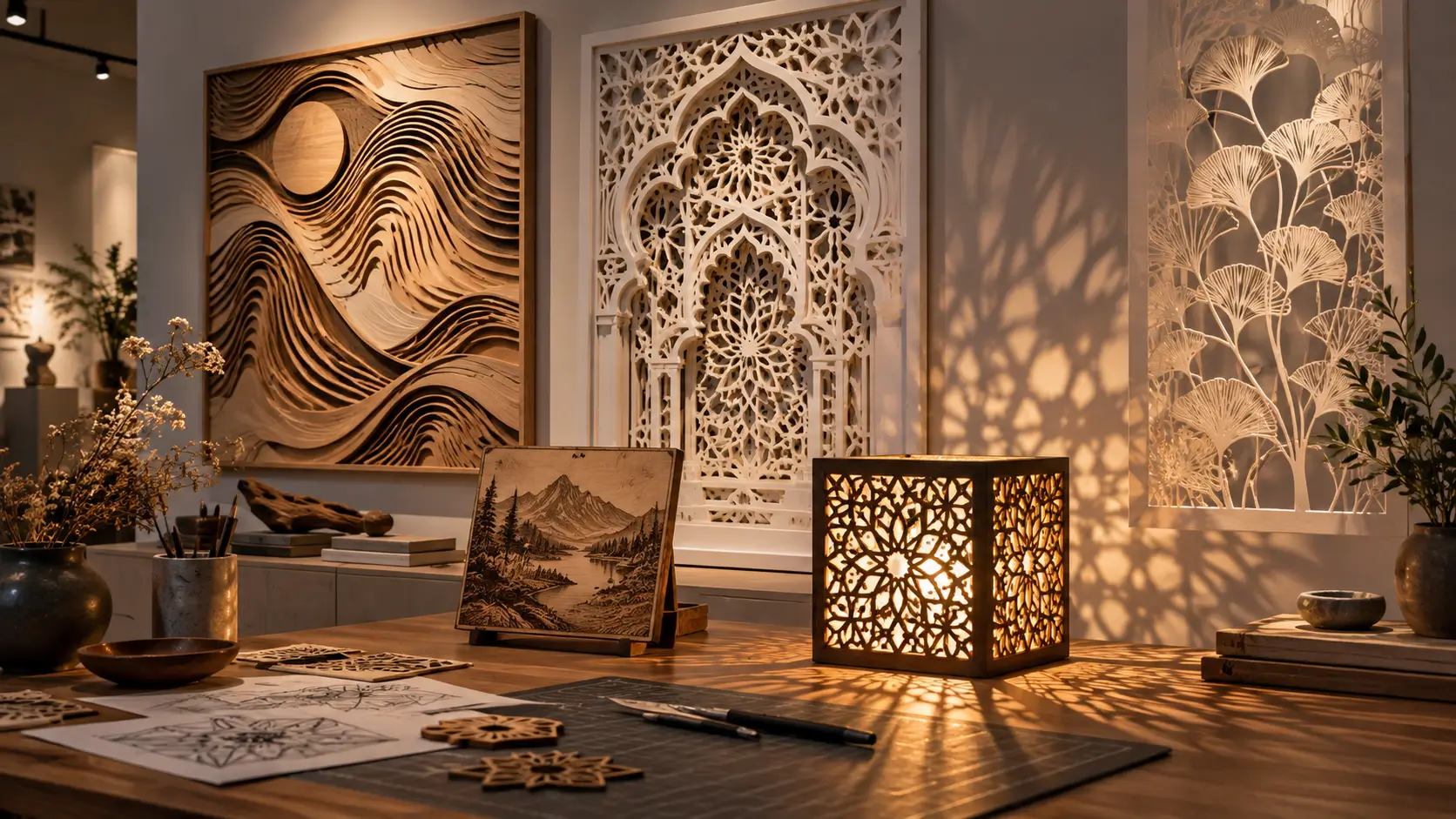
The most widely recognised laser cutting artists include Gabriel Schama for layered plywood relief sculpture, Eric Standley for intricate layered paper work, Anila Quayyum Agha for laser-cut lightbox installations that project pattern across entire rooms, and Martin Tomsky for narrative scenes built from stacked plywood. Most laser cut art uses one of five techniques: layered relief, paper layering, backlit shadow casting, tonal engraving, or cut textiles. Nearly all of it is produced on a CO2 laser, because wood, paper, acrylic, leather and fabric all absorb that wavelength efficiently.
Key takeaways
- Almost all laser cut art is made on a CO2 laser. Wood, paper, acrylic, leather and textiles absorb 10.6 microns efficiently. A fiber laser cannot process any of them.
- Depth comes from layers, not from cutting deeper. A laser cuts through material rather than carving into it, so relief and dimension are built by stacking separately cut sheets.
- The design work happens before the machine. Every artist here starts with vector illustration or hand drawing. The laser executes a file; it does not generate one.
- Material thickness drives the look. Thin plywood and card allow many layers and fine detail. Thicker stock gives bolder shadows and fewer layers.
- Assembly is usually manual and slow. Cutting a Schama or Standley piece takes hours. Gluing the layers by hand takes considerably longer, and some works take years.
Laser cutting is usually associated with manufacturing, and it is not the first technology most people connect with fine art. Yet a generation of artists has built entire practices around it, using the precision to produce work that would be impossible to cut by hand.
This guide covers fourteen of them. For each, you will find what they make, what they are known for, and, because this is written by people who run these machines daily, the technique behind the effect. If you have ever looked at a layered wood relief and wondered how it was actually built, that part is here too.
The Five Techniques Behind Laser Cut Art
Almost everything in this article is a variation on one of five approaches. Recognising them makes the work much easier to read, and much easier to attempt.
Technique | How It Works | Typical Material | Artists Using It |
|---|---|---|---|
Layered relief | Multiple sheets cut separately, then stacked and glued to build depth | 3 mm plywood, mahogany ply | Schama, Tomsky, Abarbanel |
Paper layering | Dozens or hundreds of thin card layers assembled into a single image | Cardstock, watercolour paper | Standley, Hari & Deepti |
Backlit shadow casting | A single cut panel lit from behind or within, projecting pattern onto surroundings | Plywood, steel, card | Agha, Rosenblatt, Raudenbush |
Tonal engraving | Raster engraving at varied power to produce shading rather than cut-through | Cherry, maple, birch ply | SpaceWolf |
Cut textiles and sheet | Fabric or acrylic cut into openwork patterns, often welded or layered | Fabric, acrylic, leather | Boontje, van Strien, Jacobson |
One point worth understanding before you look at the work: a laser cuts through material, it does not carve into it. Every sense of depth you see in a laser cut relief was built by stacking. That is why these pieces take so long. The cutting is fast; the assembly is not.
1. Gabriel Schama
Oakland, California · Layered plywood relief · Known for mandala-like faces in stacked mahogany ply
Schama produces densely layered wood reliefs that read almost as three-dimensional canvases. His pieces typically feature human silhouettes filled with geometric or mandala-like structure, drawing on religious art and natural forms. He also works in cut paper, leather and acrylic, but plywood is the core of the practice.
Technique: each piece begins as a complex vector illustration. That file is cut from thin mahogany plywood as multiple separate layers, which Schama then glues by hand, one piece at a time. The depth comes entirely from the stack. He has also collaborated on projection-mapped versions, where animated light is aligned to the physical contours of the sculpture.
2. Tord Boontje
London, UK · Cut textiles and interiors · Known for delicate botanical openwork
Boontje combines laser cutting with folk and botanical motifs to produce work that feels traditional rather than technological. His interiors and lighting pieces use cut material to control light and shadow, which he has described as being like embroidery with light. He has worked extensively with Danish textile house Kvadrat.
Technique: cut textile and sheet material layered to filter light. Because fabric edges seal as the laser cuts them, intricate openwork can be produced without fraying or hemming, which is the property that makes this style practical at all.
3. Anila Quayyum Agha
Pakistani-born, US-based · Backlit installation · Known for Intersections
Agha's installation Intersections is among the best-known laser cut artworks in the world. A laser-cut wooden cube is lit from within, casting intricate geometric shadows across every surface of the room it occupies. The pattern draws on the Alhambra in Granada, and the piece explores her relationship with Islamic religious spaces. Intersections won the Public Vote Grand Prize at ArtPrize in 2014.
Technique: the cube itself is comparatively simple. The art is in the shadow, which means the design has to be resolved for how it will project rather than how it looks flat. Pattern density, the distance from the light source, and the scale of the room all change the result.
4. SpaceWolf
Illustrator and engraver · Tonal wood engraving · Known for pop-culture wood posters
SpaceWolf produces illustrated wood panels that read as shaded drawings rather than cut work. Pieces start as ink illustrations, are engraved into cherry wood, and are then hand-finished. The artist plants a tree for every piece sold.
Technique: this is raster engraving rather than cutting. Varying laser power across the image produces different burn depths and therefore different tones, which is how the shading is achieved. The wood is sanded and oiled before engraving and hand-painted with acrylics afterwards.
5. Martin Tomsky
London, UK · Layered plywood illustration · Known for narrative fantasy scenes
Tomsky builds detailed illustrative scenes from stacked plywood, ranging from small jewellery pieces to large wall works. The larger pieces have a strong narrative quality, densely populated with animals, plants and architectural detail.
Technique: layered relief using stained plywood, where the staining adds tonal variation between layers that plain ply would not give. The illustration is resolved as separate depth planes before cutting, which is the part that takes the skill.
6. Joshua Abarbanel
Santa Monica, California · Wood sculpture · Known for coral-inspired wall works
Abarbanel makes three-dimensional wood sculptures and wall pieces that combine organic forms with industrial geometry. His coral reef-inspired works are the best known. He also incorporates rock, concrete and other materials.
Technique: layered relief pushed further into sculpture, with the stack depth becoming the primary form rather than a means of adding detail to a flat image.
7. Treeline & Tide
Jenn and Damian Liddiard · Wood jewellery and accessories · Known for hand-drawn pendants
A partnership between an artist and a former architect, producing laser-cut wooden jewellery, pendants, belt buckles and small accessories. Each design begins as a hand drawing before being vectorised and cut.
Technique: small-scale cutting in thin hardwood and ply, where the constraint is minimum feature size. Fine detail that works at wall-art scale disappears entirely at pendant scale, so the drawings are simplified deliberately for the size.
8. John Edmark
Designer and sculptor · Geometric and kinetic work · Known for mathematical spirals
Edmark designs work based on mathematical patterns found in nature, particularly spirals and phyllotaxis. Many pieces are kinetic, revealing their structure as they move or as the viewer's position changes.
Technique: precision cutting where the geometry is generated parametrically rather than drawn. This is a category of laser work where the design tool matters more than the machine, because the forms are calculated rather than illustrated.
9. Eric Jacobson
San Jose, California · Layered acrylic sculpture · Known for illuminated human forms
Jacobson works across acrylic, glass, wood and metal, with much of his practice centred on the human figure and particularly the head. His layered acrylic pieces build transparent forms from stacked cut sections, often incorporating LEDs.
Technique: layered relief in clear and coloured acrylic rather than wood. Acrylic behaves very differently: a CO2 laser produces a flame-polished edge that stays optically clear, which is what allows light to travel through the stack. That edge quality is specific to CO2 and is why acrylic sculpture of this kind is a laser technique rather than a router one.
10. Martijn van Strien
Netherlands · Laser-cut fashion · Known for the Contradictions collection
A Dutch fashion designer whose label mphvs launched the Contradictions collection in 2014, featuring laser-cut fabric panels with architecturally derived geometric patterns and welded rather than sewn seams.
Technique: cutting synthetic textile, where the heat of the laser seals the cut edge. That sealed edge is what makes unhemmed openwork garments structurally viable, and welding the seams removes stitching entirely. Note that many synthetic fabrics are unsuitable for laser processing, so material selection here is a safety decision as much as a design one.
11. Mathew Rosenblatt
Toronto, Canada · Illuminated steel sculpture · Known for Symbolic Peace
Rosenblatt created Symbolic Peace, a public installation in Toronto made from cold-rolled steel, perforated with laser-cut symbols drawn from the religious and cultural communities around it, and lit from inside.
Technique: backlit shadow casting in metal rather than wood. Cutting steel at this scale is industrial fiber or plasma work rather than a workshop CO2 machine, which is worth knowing if you are looking at this piece and wondering what it would take.
12. Kate Raudenbush
New York City · Large-scale sculpture · Known for Burning Man installations
Raudenbush produces large architectural sculptures using laser-cut wood lattices and panels, widely shown at Burning Man and in institutional collections. Many pieces function as shelter or meditation spaces and incorporate LED lighting to extend the shadow work after dark.
Technique: backlit shadow casting at architectural scale. The design challenge is structural as much as visual, because a lattice that removes enough material to cast good shadows also has to hold itself up.
13. Eric Standley
Virginia, USA · Layered paper · Known for Gothic and Islamic geometric compositions
Standley produces layered paper works of extraordinary density, drawing on the geometry of Gothic and Islamic architecture. A single piece can take years to complete, built from dozens or hundreds of individually cut paper layers assembled into one image.
Technique: paper layering taken to its limit. Each layer is cut separately and contributes a fraction of the final image, so the file preparation is as demanding as the assembly. Paper cuts cleanly on a CO2 laser at low power, which is what makes this level of intricacy achievable at all.
14. Hari & Deepti
Harikrishnan Panicker and Deepti Nair · Illuminated paper shadow boxes · Known for theatrical lit dioramas
This partnership produces cut-paper shadow boxes lit from within, creating layered scenes with genuine depth. Photographed in darkness, the works take on a strongly theatrical quality.
Technique: paper layering combined with backlighting. Layers are spaced rather than glued flat, so light passes between them and produces graduated depth instead of a single silhouette. The spacing is as important to the effect as the cutting.
What These Artists Have in Common
The file matters more than the machine. Every artist here starts with illustration, whether drawn by hand and vectorised or built digitally. The laser executes a design; it does not create one. A better machine cuts the same file faster and cleaner, but it will not improve the drawing.
Depth is built, not cut. A laser cuts through. Every relief, every sense of dimension in this article, was assembled from separately cut layers. This is the single most common misconception about laser cut art.
Assembly dominates the timeline. Cutting is the fast part. Gluing a layered relief or spacing a hundred paper layers is where the hours go, and it is entirely manual.
Material thickness is a design decision. Thin stock allows more layers and finer detail. Thicker stock gives bolder shadow lines and fewer layers. Neither is better; they produce different work.
Nearly all of it is CO2. Wood, paper, acrylic, leather and fabric all absorb 10.6 microns well. The exceptions here are the metal pieces, which are industrial cutting rather than workshop work.
How to Start Making Laser Cut Art
1. Pick one technique, not a style. Layered relief, paper layering and backlit shadow casting are three different disciplines. Trying to learn all three at once means learning none of them properly.
2. Start with fewer layers than you want. A three-layer relief teaches you registration, glue behaviour and how depth actually reads. Attempting twenty layers first usually produces an expensive mess.
3. Resolve the drawing before you cut anything. Separating an illustration into depth planes is the real skill, and it happens in software. Machine time cannot fix a design that was not planned in layers.
4. Test your minimum feature size. Cut a test sheet with progressively finer detail on your actual material. Every machine and material combination has a point below which detail stops surviving, and knowing yours prevents wasted stock.
5. Plan for registration. Stacked layers need to align. Alignment holes, jigs or a cut base plate are worth building before the first real piece, not after the first misaligned one.
On the machine side, all of this is CO2 territory. Our comparison of CO2 vs fiber lasers covers why, and our guide to materials that are not suitable for laser cutting covers what to avoid, which matters particularly if you are experimenting with fabrics and foams.
Seeing the Technique
Once you can identify the five techniques, laser cut art becomes much easier to read. A relief that seems carved is stacked. A room full of pattern comes from a single cut panel and a light source. A shaded wood portrait is raster engraving at varying power, not cutting at all.
None of it requires an unusual machine. What it requires is design skill, patience with assembly, and a clear idea of which technique you are pursuing. If you are working out what a machine would let you make, our guide to whether laser engraving is profitable covers the commercial side, including why assembly time rather than cutting time determines what a piece actually costs you to produce.
Frequently asked questions
Who is the most famous laser cutting artist?
Gabriel Schama and Eric Standley are the two most widely recognised, Schama for layered plywood relief and Standley for layered paper. Anila Quayyum Agha's installation Intersections is arguably the single best-known individual laser cut artwork, having won the Public Vote Grand Prize at ArtPrize in 2014.
What kind of laser do artists use for laser cut art?
Almost universally a CO2 laser. Wood, paper, acrylic, leather and fabric all absorb the 10.6 micron wavelength efficiently. A fiber laser operates at around 1,064 nm and cannot process any of those materials usefully, which is why it does not appear in this kind of work.
How is depth created in laser cut art?
By stacking. A laser cuts through material rather than carving into it, so artists cut multiple separate layers and assemble them. The apparent depth in a Schama or Tomsky piece comes entirely from that stack, not from the laser cutting to varying depths.
What material is most commonly used?
Thin plywood, typically around 3 mm, is the most common for relief work, with mahogany ply favoured for its colour and consistency. Cardstock and watercolour paper dominate layered paper work, and acrylic is used where light needs to travel through the piece.
How long does a layered laser cut artwork take to make?
The cutting is usually hours. The assembly is where the time goes, because every layer is glued or spaced by hand. Complex paper works can take months, and Eric Standley has described individual pieces taking several years.
Can you make laser cut art with a small desktop machine?
Yes. Layered relief, paper layering and shadow boxes are all achievable on a modest CO2 machine, because the material is thin and the bed size limits piece size rather than technique. Bed size is the main constraint on scale, not power.
Do these artists design their own files?
Yes, and that is the bulk of the work. Designs start either as hand drawings that are vectorised or as vector illustration built directly in software. Separating an image into depth planes is the skill that distinguishes this work, and it happens before the machine is switched on.
Is laser cut art profitable to sell?
It can be, and several artists here sell at both gallery and accessory price points. The economics depend heavily on assembly time, since that is manual and does not scale with a faster machine. Work that repeats, such as jewellery and small accessories, amortises design time far better than one-off commissions.