
Double Lines and Nozzle Clipping:
VIDEO VISUAL
Applies to: Nova and Titan series CO₂ lasers with a rear tube and three flying mirrors
Quick answer: A small beam angle error that a 2.0″ lens tolerates can clip the inside of the nozzle with a 4.0″ lens. The clipped part of the beam reflects off the nozzle wall and lands beside the main spot as a ghost line. The fix is beam alignment. The lens is not faulty.
Symptoms
A faint second line beside cut or engraved lines.
The second line shows in one area of the bed and fades in another.
The problem appeared after changing to a longer lens.
Cuts are weaker than expected for the power setting.
The beam path
The beam leaves the tube at the rear, turns at mirror 1, travels along the side of the machine to mirror 2 on the gantry, then crosses the gantry to mirror 3 on the head. Mirror 3 turns it 90° downward through the focus lens and out of the nozzle.
The seven figures that follow are from a ray trace of the head. Each shows a side view of the head, a magnified view of the nozzle tip, and what lands on the material.
How a small error builds up
1. Aligned
A 2.0″ lens, the Nova standard. The beam leaves mirror 2 level and on center, hits the middle of mirror 3, runs straight down the tube and through the middle of the lens. The focused cone clears the nozzle with room on both sides.
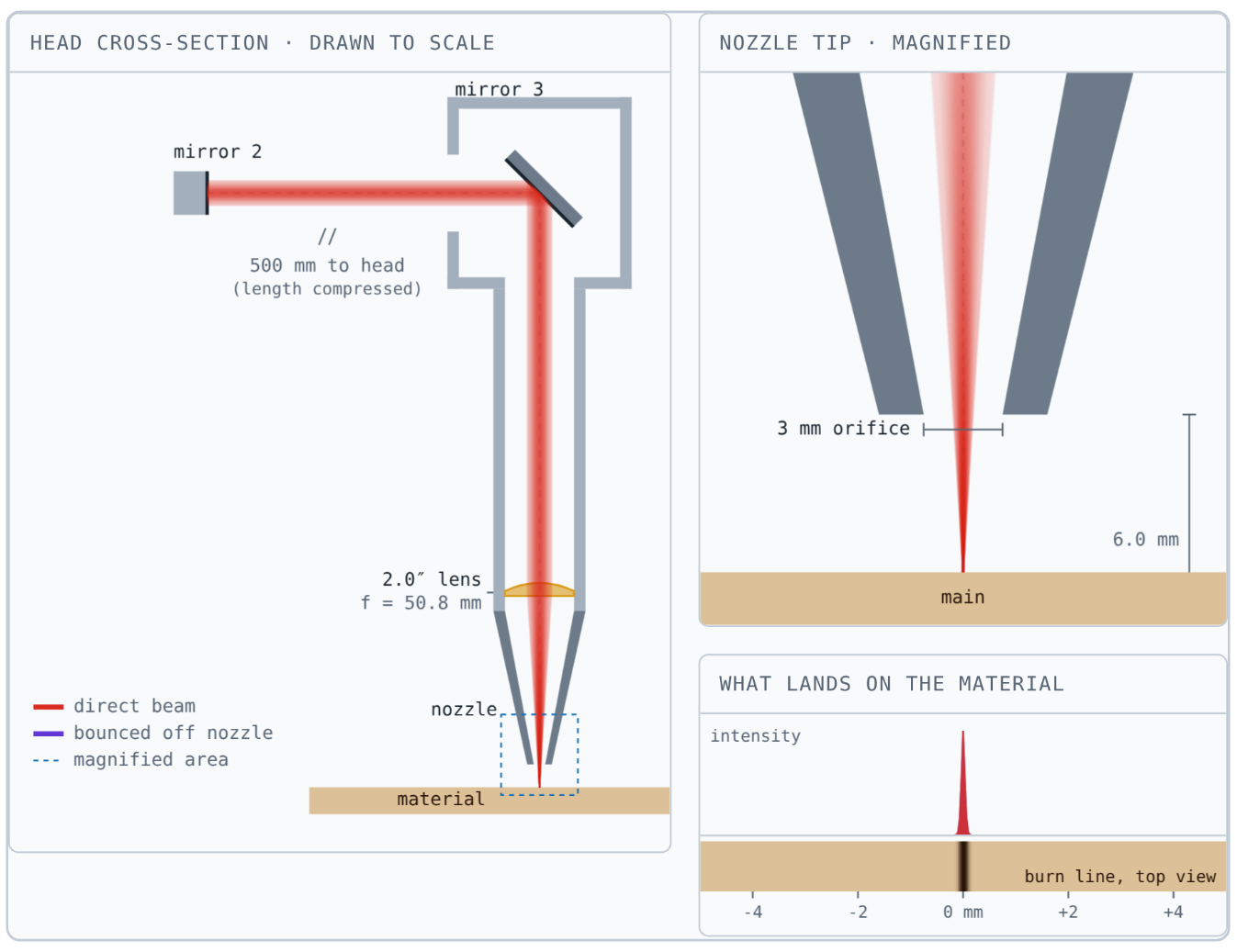
Result: Clean exit. The whole cone clears the orifice and lands as one spot.
Setup: 2.0″ lens · head 500 mm from mirror 2 · beam angle out of mirror 2 0.00° · mirror 3 tilt 0.00°
Spot walk on mirror 3 0.00 mm · focus shift 0.00 mm · exit lean 0.0° · direct 100% / bounced 0%
2. A small angle out of mirror 2
When the beam arrives at mirror 2 off its mark, it leaves at a slight angle. Here it climbs 0.15°. With the head parked close to mirror 2 that is only 0.3 mm of error, which is hard to see on a tape test.
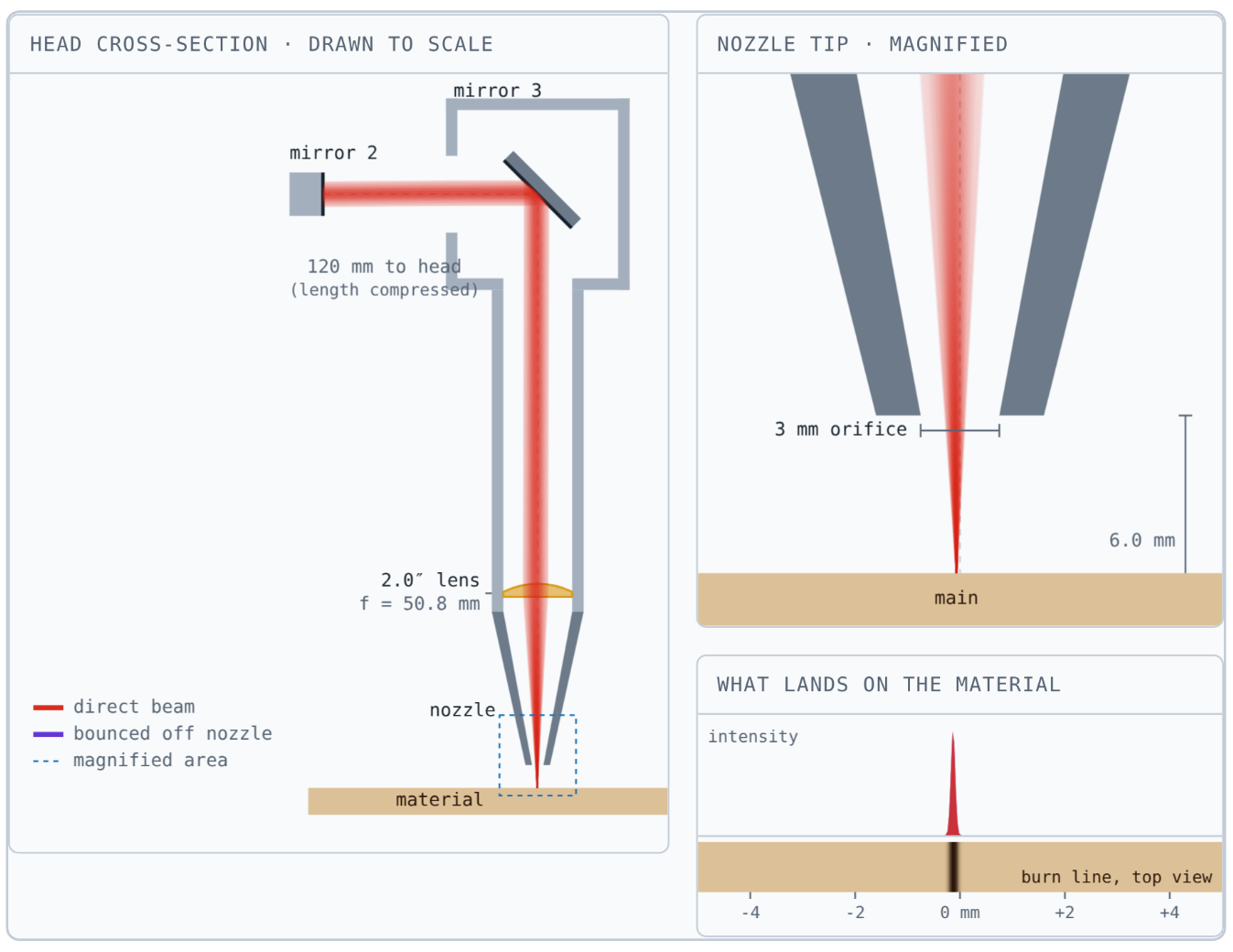
Result: Clean exit. The whole cone clears the orifice and lands as one spot.
Setup: 2.0″ lens · head 120 mm from mirror 2 · beam angle out of mirror 2 0.15° · mirror 3 tilt 0.00°
Spot walk on mirror 3 0.31 mm · focus shift 0.13 mm · exit lean 0.5° · direct 100% / bounced 0%
3. The error grows with travel
Run the head to the far side. The same 0.15° now puts the beam 2.5 mm high on mirror 3, so it drops into the lens off center. The lens still steers it to the focal point, so it clears the nozzle, but it leaves leaning about 3°.
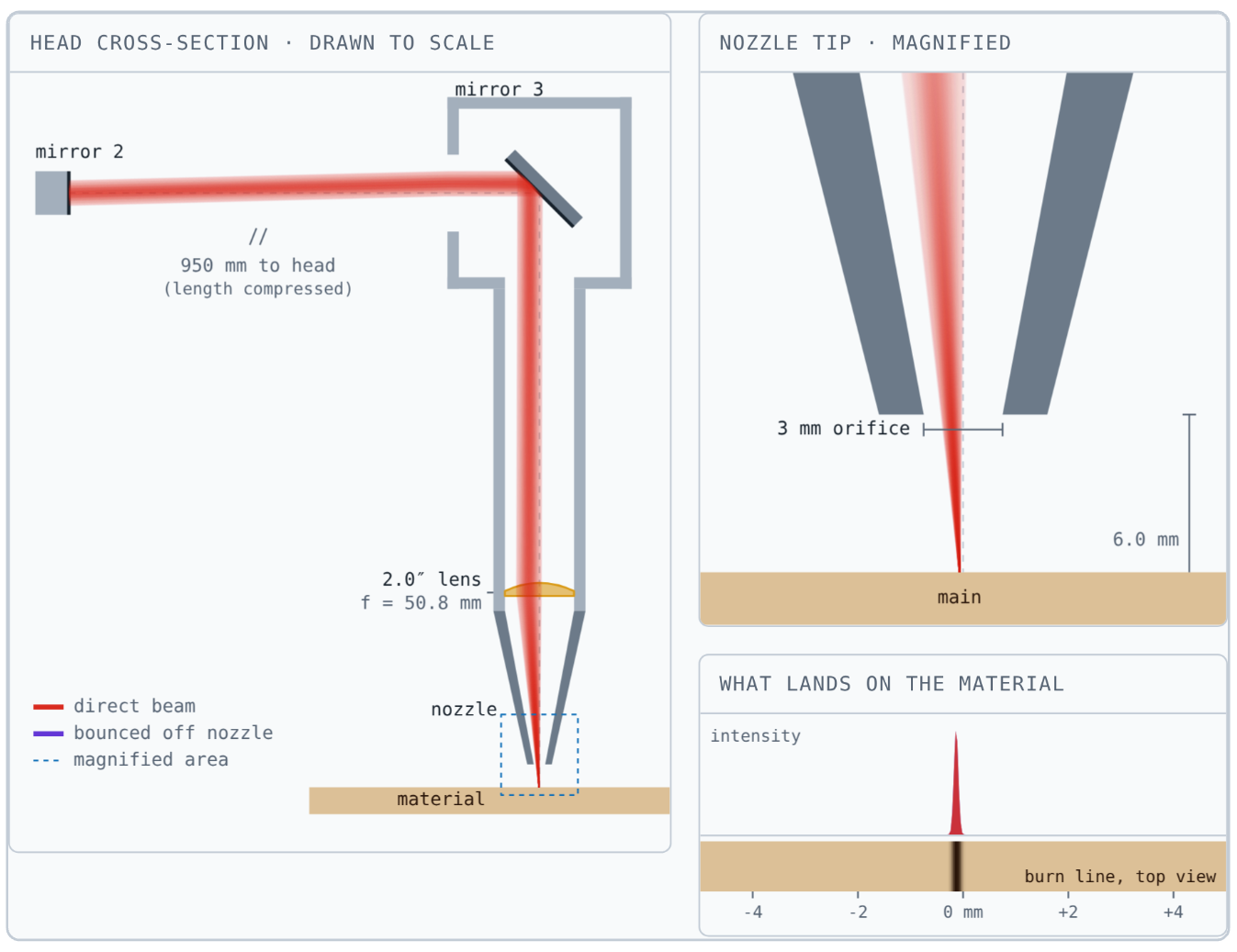
Result: Clean exit, leaning. The whole cone clears the orifice, but it leaves the nozzle 3.0° off vertical, which angles the kerf.
Setup: 2.0″ lens · head 950 mm from mirror 2 · beam angle out of mirror 2 0.15° · mirror 3 tilt 0.00°
Spot walk on mirror 3 2.49 mm · focus shift 0.13 mm · exit lean 3.0° · direct 100% / bounced 0%
4. Add a slightly tilted mirror 3
Now tilt mirror 3 by 0.28°. The beam runs down the tube at an angle, and the focal point shifts sideways by focal length × tilt. With a 2.0″ lens that is about 0.6 mm, and the cone still clears the orifice.
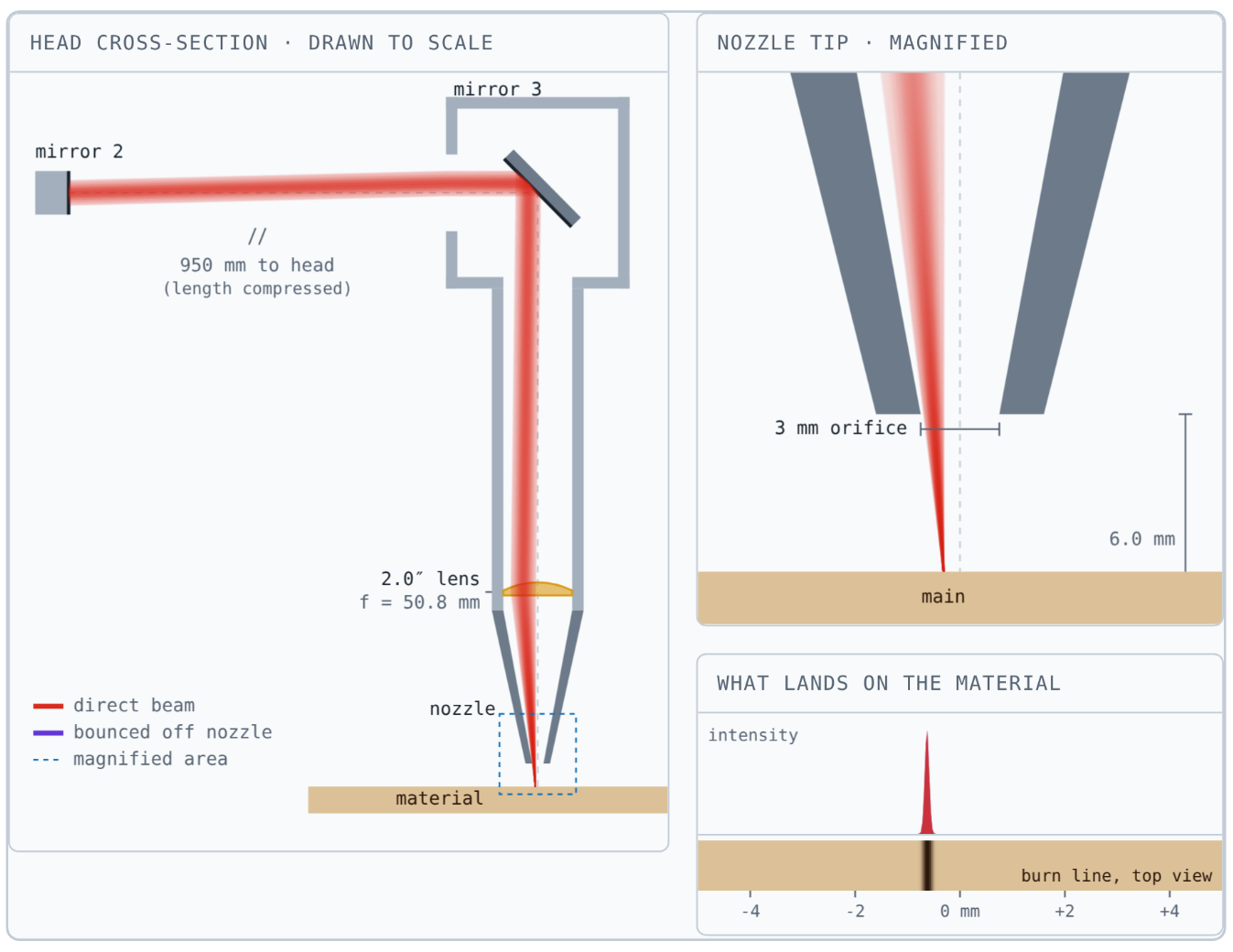
Result: Clean exit, leaning. The whole cone clears the orifice, but it leaves the nozzle 3.6° off vertical, which angles the kerf.
Setup: 2.0″ lens · head 950 mm from mirror 2 · beam angle out of mirror 2 0.15° · mirror 3 tilt 0.28°
Spot walk on mirror 3 2.49 mm · focus shift 0.63 mm · exit lean 3.6° · direct 100% / bounced 0%
5. Same error, 4.0″ lens
Swap to a 4.0″ lens. It sits about twice as high in the tube, so the tilted beam drifts about twice as far before it reaches the tip. One edge of the cone strikes the nozzle wall, reflects, and exits as a second beam. On the work that is a ghost line a few millimetres from the main one.
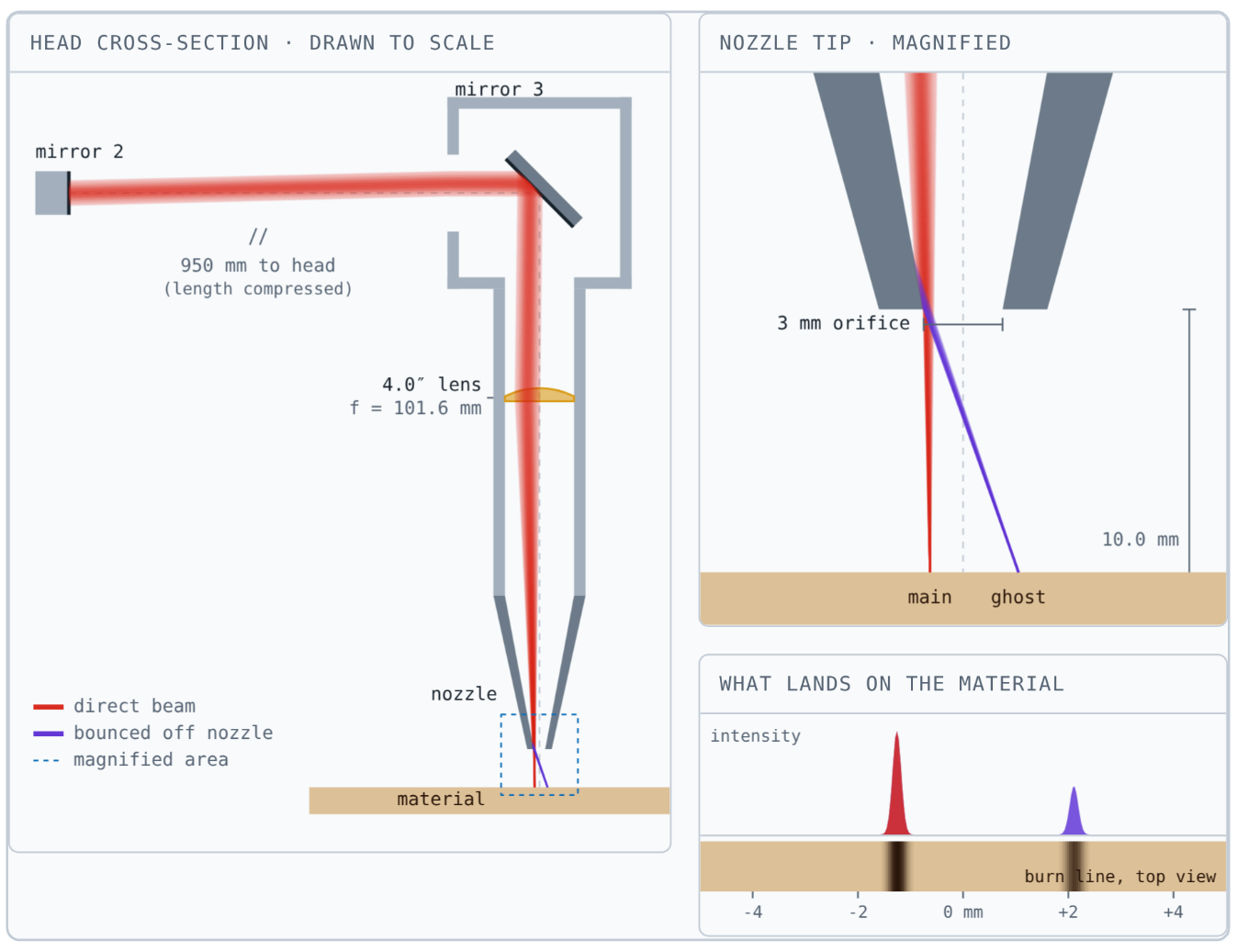
Result: Clipping the nozzle. 32% of the beam reflects off the inside of the nozzle and lands about 3.4 mm from the main spot.
Setup: 4.0″ lens · head 950 mm from mirror 2 · beam angle out of mirror 2 0.15° · mirror 3 tilt 0.28°
Spot walk on mirror 3 2.49 mm · focus shift 1.26 mm · exit lean 1.1° · direct 68% / bounced 32%
6. It comes and goes with head position
Bring the head back toward mirror 2. The spot walk shrinks, the beam clears the wall again, and the ghost fades. A double line that shows in one area of the bed and not another points to the beam angle coming into the head.
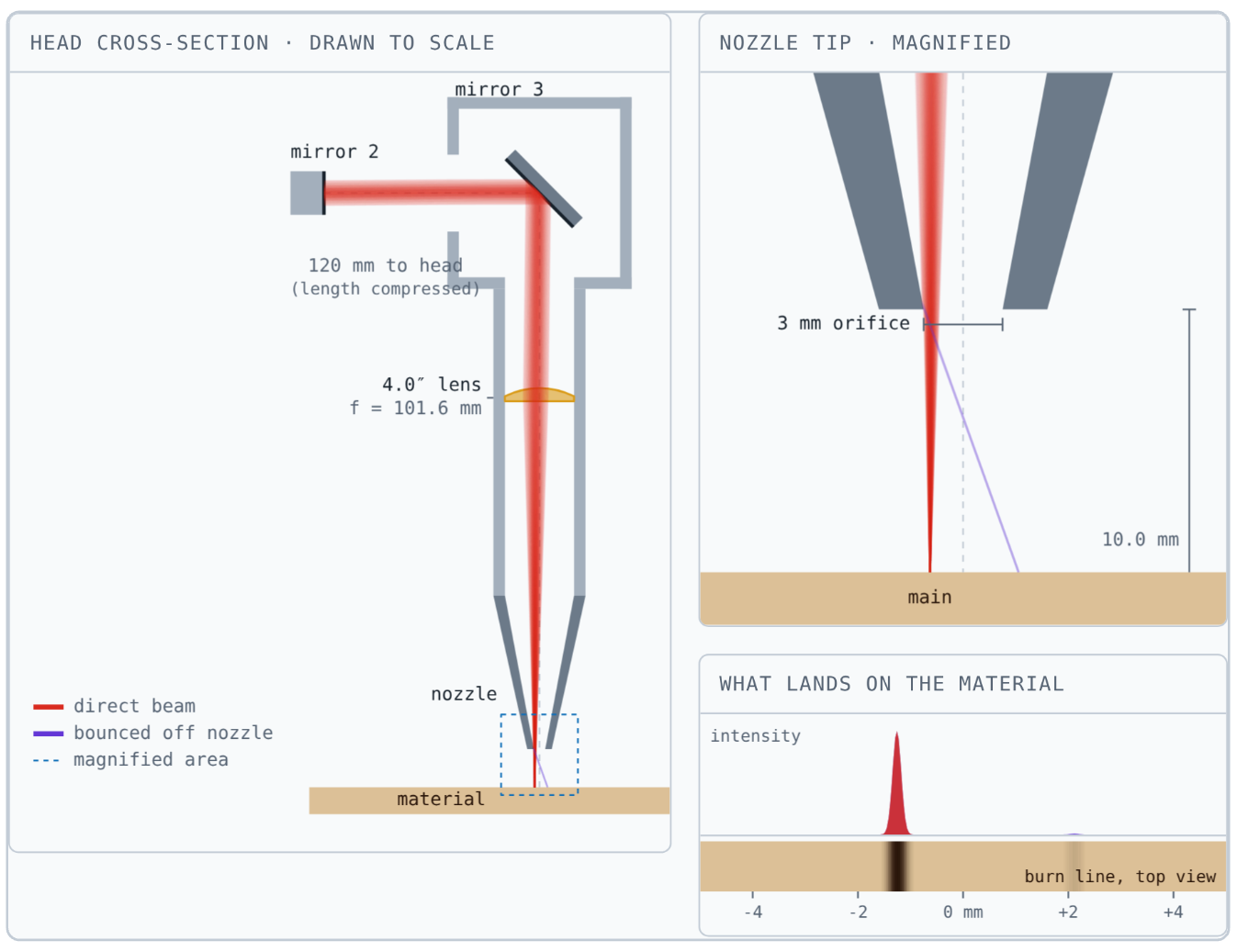
Result: Clean exit. The whole cone clears the orifice and lands as one spot.
Setup: 4.0″ lens · head 120 mm from mirror 2 · beam angle out of mirror 2 0.15° · mirror 3 tilt 0.28°
Spot walk on mirror 3 0.31 mm · focus shift 1.26 mm · exit lean 0.2° · direct 99% / bounced 1%
7. Realigned
With the beam level out of mirror 2 and mirror 3 square, the 4.0″ lens exits clean across the whole bed. The long lens does not cause the fault. It leaves less margin for the same error.
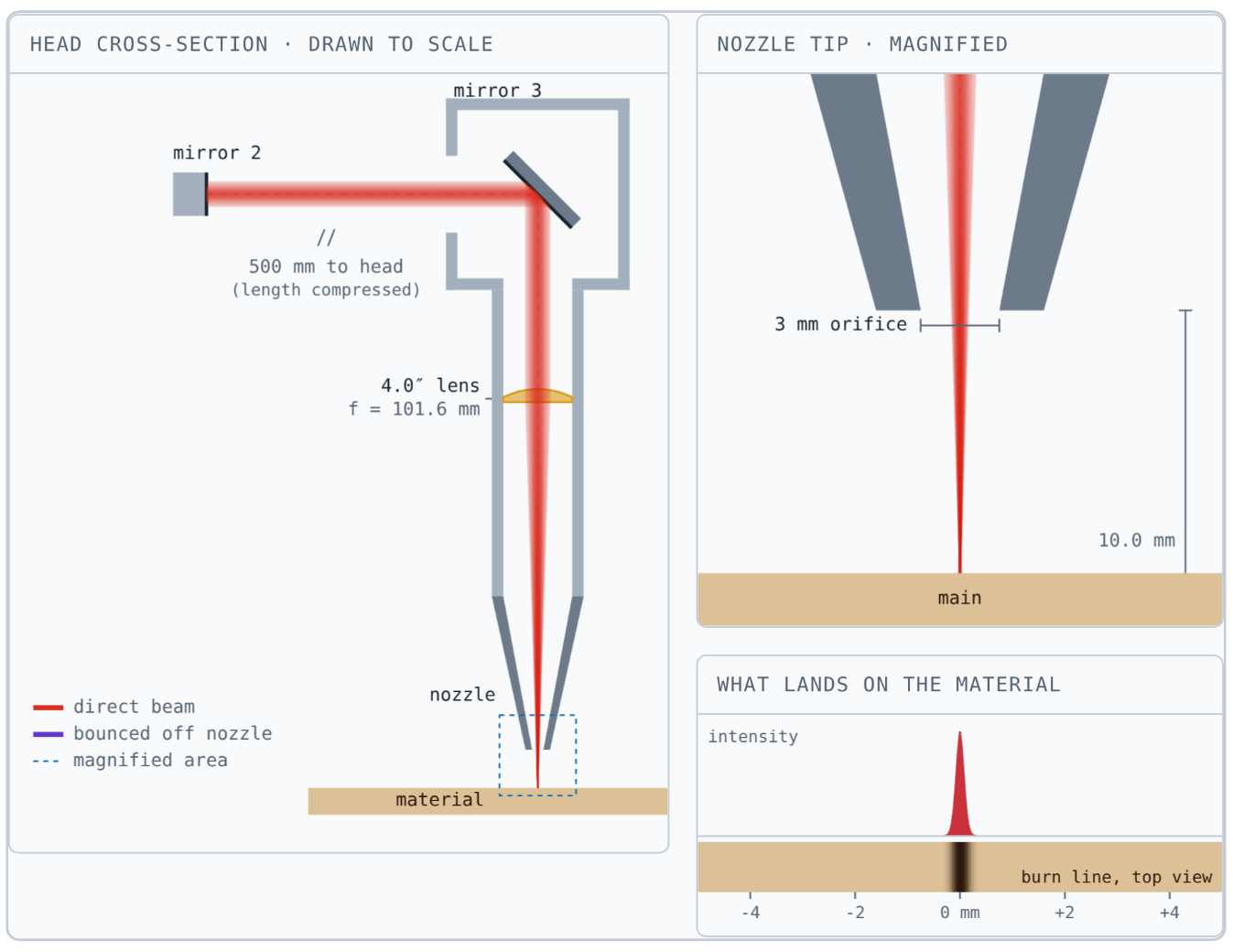
Result: Clean exit. The whole cone clears the orifice and lands as one spot.
Setup: 4.0″ lens · head 500 mm from mirror 2 · beam angle out of mirror 2 0.00° · mirror 3 tilt 0.00°
Spot walk on mirror 3 0.00 mm · focus shift 0.00 mm · exit lean 0.0° · direct 100% / bounced 0%
Same error, four lenses
This table uses the error from steps 4 and 5: the beam leaves mirror 2 at 0.15°, mirror 3 is tilted 0.28°, and the head is 950 mm from mirror 2.
Lens | Focal length | Nozzle gap in model | Focus shift on the work | Exit lean | Beam bounced off nozzle |
|---|---|---|---|---|---|
1.5″ | 38.1 mm | 3.5 mm | 0.47 mm | 5.2° | 0% |
2.0″ | 50.8 mm | 6.0 mm | 0.63 mm | 3.6° | 0% |
2.5″ | 63.5 mm | 6.0 mm | 0.79 mm | 2.6° | 0% |
4.0″ | 101.6 mm | 10.0 mm | 1.26 mm | 1.1° | 32% |
Short lenses shift the focus less but leave the nozzle at a steeper lean, which angles the kerf. Long lenses lean less but shift the focus more, which is what brings the beam into the nozzle wall.
Why it happens
Angle is the error that reaches the nozzle. A beam that is parallel but off center still gets steered to the focal point by the lens. A beam that is tilted moves the focal point itself, by focal length × tilt.
A longer lens doubles the lever arm. A 4.0″ lens sits about twice as far from the nozzle tip as a 2.0″ lens. The same tilt drifts about twice as far sideways before it reaches the orifice.
The bounce makes the second line. When one edge of the converging cone grazes the inside of the nozzle, it reflects and leaves the orifice on a different path. That is the ghost line beside the main one.
What to check
Mirror 3, near and far. Compare where the beam lands on mirror 3 with the head close to mirror 2 and at the far end of the gantry. If the spot moves, the beam is leaving mirror 2 at an angle.
Center of the nozzle. Confirm the beam exits the center of the nozzle. If it is centered on mirror 3 but off center at the nozzle, mirror 3 is tilting the beam.
Repeat with the long lens installed. An alignment that passes with a 2.0″ lens can still clip with a 4.0″ lens, because the long lens leaves less margin.
Ramp test after any lens change. Each lens needs its own focus distance.
About the model
The figures come from a 2D geometric ray trace. The lens set follows the Nova and Titan options: 1.5″, 2.0″, 2.5″ and 4.0″ nominal focal lengths, with 2.0″ standard on Nova and 2.5″ standard on Titan. Nozzle-to-work gap follows the Nova reference focus gaps: about 3.5 mm for 1.5″, 6 mm for 2.0″ and 10 mm for 4.0″, with 2.5″ assumed at 6 mm. Titan lens tubes all hold about 5 mm. The raw beam is 5 mm, the listed figure for 60 to 100 W Nova tubes.
These dimensions are assumed and are not published specifications: 18 mm lens tube bore, 3 mm nozzle orifice, nozzle cone shape, and head height. The nozzle wall is treated as a mirror at 10.6 μm and the tube wall as absorbing. The exact angle at which clipping starts will differ on a real head. The trends do not.
Still stuck?
Fastest response times in the industry from our US-based support team.