
Thunder Laser Class I Machine Considerations
The information below is a discussion about the Class I capability of machines that are shipped from the factory in a Class II configuration.
1) Which machines are Class 1?
Are all of these machines Class 1?
- Aurora series is Class 1. (As of 2026, production machine serial 2538317 and higher in USA market)
- The Titan, Bolt Series are now Class 1 capable. Because Aurora, Bolt, Titan have laser shutter in the machine, and are shipped with Class I controller firmware.
- For Nova Plus machine, the laser shutter has not been added and the firmware is Class II so the Nova Plus series is still a Class II Product.
Why we say Titan Bolt machines are Class 1 capable?
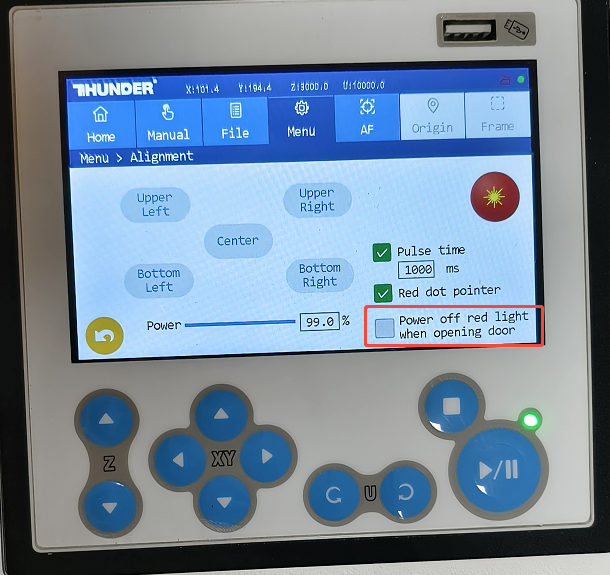
Because for default setting before shipping, we did not select to turn off the visible red laser when any door is opened.
Laser Classification and User Configuration: The machines ship as Class 2 lasers, but users can configure them to meet Class 1 standards by setting limits on the XYZ axis and the red dot pointer.
On control panel → Menu → Factory Setting, you can change the setting:
2) What makes them Class 1?
Safety features or design details make these machines Class 1:
- Enclosed Structure and Enclosure Protection
- Safety Interlock System (Lid-Open Protection, Door/Cover Protection)
- Laser shutter
- Class 1 controller firmware.
All these ensure that when users open the door by accident, the laser will stop, and the XYZ axis cannot move, so users cannot be exposed to any laser damage.
Certainly there is maintenance mode for Class 1 laser products too, please note when in maintenance mode, it means we can get access to the Class IV laser with doors open. So when in maintenance mode, this product is Class IV instead of Class I or II product.
3) Who decides what "Class 1" means?
What official group or standard defines Class 1?
From: https://www.laserax.com/blog/class-1-laser-products-regulations?utm_source
A class 1 laser product is a device that complies with laser safety standards from the International Electrotechnical Commission (IEC).
IEC 60825-1 is the primary international classification standard and serves as the compliance benchmark for many countries, including the European Union's EN 60825-1.
The FDA has statutory authority over products entering the U.S. market, may adopt IEC classifications, and permits the use of equivalent testing strategies.
4) Is this officially tested, or self-declared?
The Class I certification is self-declared. But we have done necessary tests and get the reports.
Main tests are:
- EN 60825-1 (laser classification)
- Machinery Directive (MD)
Note: Class II Product is FDA standard. Our Nova, Titan, Bolt are all Class II Products. Because the machines are enclosed, when the door is opened, users cannot get access to class 4 CO2 or Fiber laser, but they can get access to the class 2 red laser (and the red laser power in work area is over 0.5 mW), so the machines are Class 2 product under FDA standard.
And for CE standard, the criteria is more strict:
The CE self-declaration for Class 1 laser compliance mainly consists of two documents: Machinery Directive (MD) Report and EN/IEC 60825 Laser Safety Report.
Machinery Directive Requirements
- Safety protection must use dual redundancy
- Dual-sensor detection is required
- Laser isolation must be achieved through:
- Signal modules
- Mechanical shutters
When the protective door is opened:
- The laser must be isolated
- XYZ axes must be disabled and immobile
IEC 60825 Requirements
With all protective doors closed:
- External radiation during full-power operation must comply with Class 1 limits
When the protective door is opened:
- If an indicator red light is present, radiation output must be below 0.5 mW or the red pointer should turn off (when door is opened).
So in the US, we have to state that machines ship as Class 2 lasers, but users can configure them to meet Class 1 standards by setting limits on the XYZ axis and the red dot pointer.
On control panel → Menu → Factory Setting, you can change the setting.
Factory Setting for Touch Panel


5) Is there an official Class 1 logo or icon?
Is there an official symbol/logo we should use when we say "Class I"?
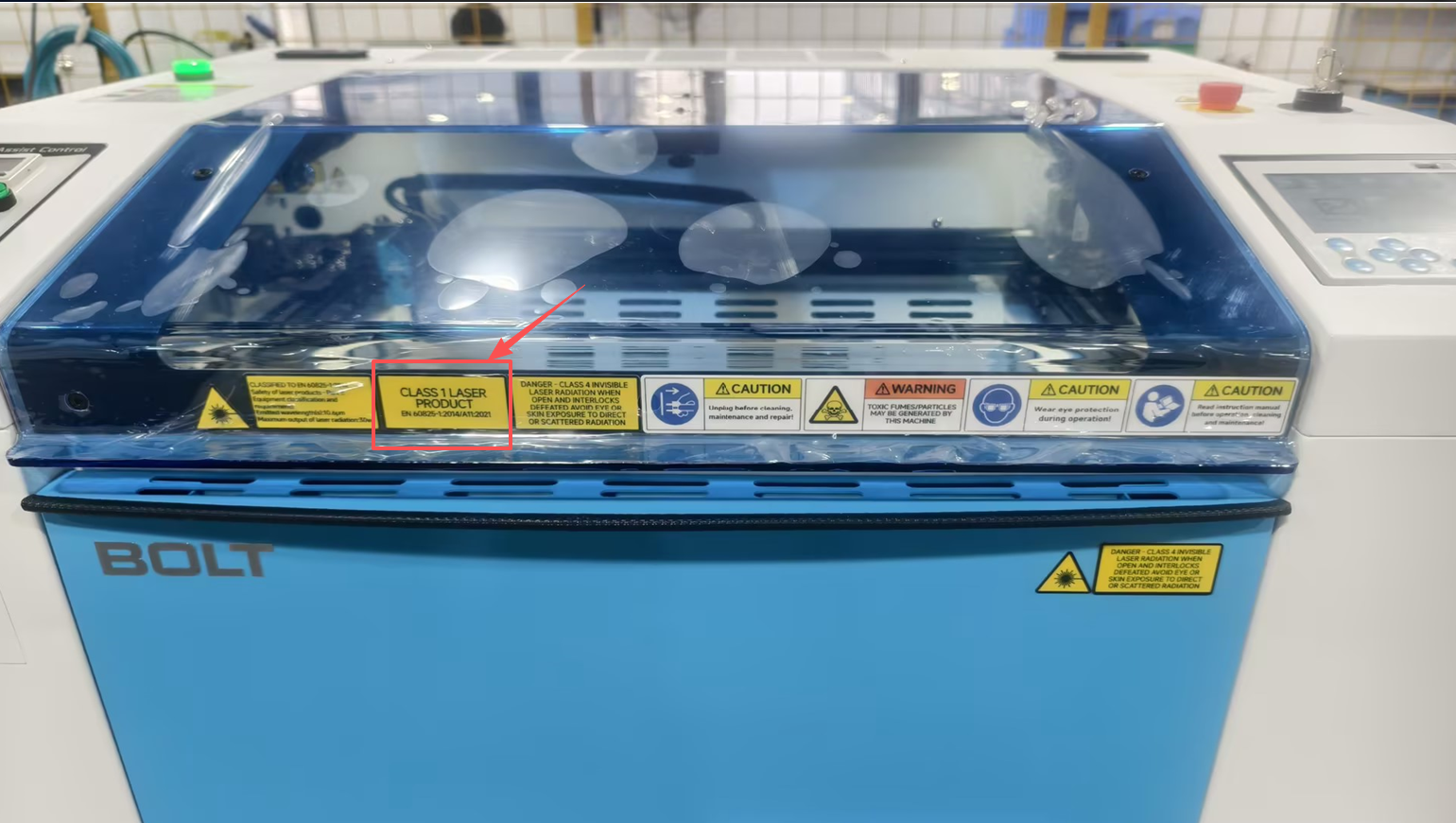
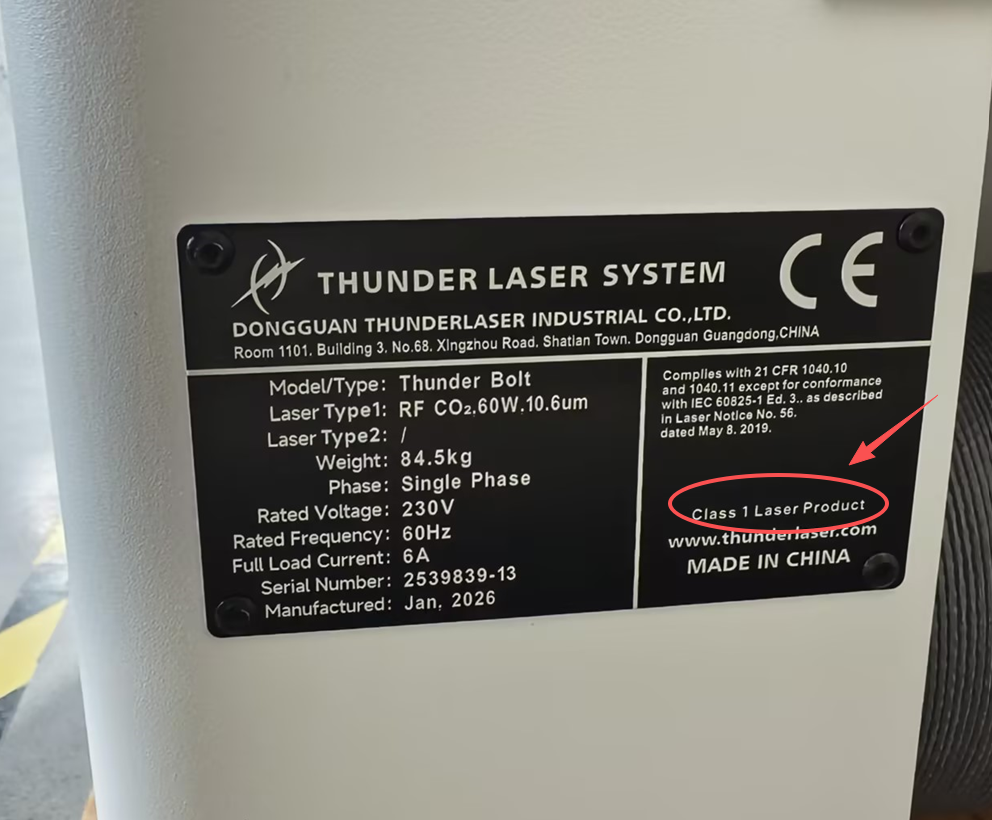
The nameplate shows a Class I identifier, and the machine sticker also displays it. See the images below:
| Machine Stickers | Machine Serial Plate |
|---|---|
 |
 |
6) Where is Class 1 recognized?
Which regions/countries accept or recognize this Class 1 rating? (For example: U.S., EU, UK, Canada, Australia, etc.)
The Class 1 rating is widely accepted globally, with specific regional recognition as follows:
- International/Global: IEC 60825-1 is universally adopted or recognized equivalently by most countries (including China, the EU, Australia, etc.). Reference: https://webstore.iec.ch/en/publication/3587?utm_source
- EU: EN 60825-1 (based on IEC 60825-1) is mandatory for CE compliance. Reference: https://www.cceeccic.org/69514333.html?utm_source
- U.S.: Recognized by the FDA and ANSI/OSHA; products must meet relevant federal regulations. Reference: https://www.osha.gov/enforcement/directives/std-01-05-001?utm_source
- UK: Equivalent recognition of EN/IEC standards, with additional UKCA compliance requirements.
- Canada: CSA E60825-1 (based on IEC 60825-1) is locally recognized. Reference: https://www.laserax.com/blog/class-1-laser-products-regulations?utm_source
- Australia/New Zealand: Generally accepts IEC/AS/NZS series standards.
7) What does Class 1 mean for the customer?
In simple terms, what benefits does Class 1 give the owner?
For end-users, Class 1 certification delivers tangible benefits:
Key Benefits (Simple Terms)
✅ Easier Safety Compliance
No need for extensive additional protective measures or complex operational controls, reducing barriers to regulatory compliance.
✅ Reduced Training Requirements
Unlike Class III/IV laser products, Class I users typically do not require specialized laser safety training, lowering training costs and onboarding time.
✅ Insurance & Liability Advantages
Lower inherent risk improves insurance coverage eligibility and may lead to more favorable premium rates.
✅ Workplace Safety (OSHA-Related)
OSHA generally does not mandate a dedicated laser safety program for Class I devices (though routine risk assessments are still recommended). Reference: https://www.osha.gov/laser-hazards/hazards?utm_source
✅ Simplified Purchasing for Schools/Public Institutions
Schools, educational facilities, and laboratories can procure Class 1 products more easily, as they align with low-risk safety policies and grant requirements for public-sector purchases.
What Does CLASS # not mean:
❌ "Absolutely risk-free" or "Safe for unrestricted viewing"
Class I safety is only guaranteed under intended normal use conditions. It does not cover misuse (e.g., damaged enclosures, tampered interlocks) which may expose hazards.
❌ Misleading medical/therapeutic claims
Class I certification relates solely to laser radiation safety—not medical efficacy or health benefits. The classification does not cover any health or medical guarantee.
Downloads
Still stuck?
Fastest response times in the industry from our US-based support team.