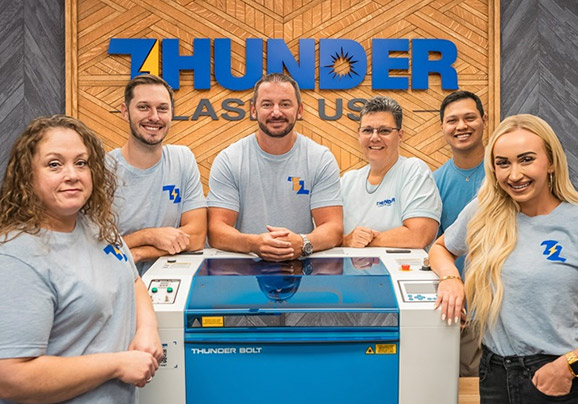
Mark the part. Trace the lot. Cut the fixture. In-house.
Permanent part numbers, serials, and 2D Data Matrix codes on steel, stainless, aluminum, cast, and coated parts, plus the fixtures, jigs, gaskets, and templates your floor runs on. One compact laser bench brings the traceability marks your customers require, and the short-run fab work, back under your own roof, from your own files, on the same shift.
Most automotive shops start with the Aurora 8-100W MOPA, starting at $11,000.
US support from coast to coast and over 1,000 five-star reviews on Trustpilot.
The traceability mark your customer wants is the one step that is not on your floor.
The PPAP asks for it, the print calls it out, the customer wants a scannable code on every part they can trace back to a lot: most shops send that marking out. It looks cheap by the piece, and that is the trap, because the vendor’s turnaround lands in the middle of your delivery week on every lot, forever, and the per-part markup leaves the building each time. The shortcuts leave marks of their own. Dot peen deforms the surface, and its codes can stop reading after coating, plating, or heat treat, which is exactly when a scan matters. Hand stamping is inconsistent and fails verification the moment a customer runs a grader on it. Meanwhile the fab work never lets up: a holding fixture for the next run, a jig for the weld cell, a gasket for a one-off, a template for the trim line. Each one is a purchase order and days of waiting. A compact laser cell closes both gaps at once.
One bench puts the mark, the margin, and the lead time back under your control.
Bring marking and short-run fab in-house and the math changes fast. You stop paying a vendor’s per-part markup, you quote shorter lead times because the mark is no longer sitting in someone else’s queue, and you keep the margin that used to leave the building on every lot. It also lets you take on the traceability work you used to turn away, the serialized job, the quick-turn fixture, the data-plate run, because that capability now lives on your own floor. For a lot of shops this one machine is the difference between quoting a job and winning it.
Marks that survive the process
A laser mark is in the surface, not stamped into it. No impact, no deformation, and a mark that stays legible and scannable after coating, plating, powder, and heat treat, when a dot-peen code can close up and stop reading. Deep, permanent part numbers, serials, and codes on steel, stainless, aluminum, and cast, the same on every part.
Traceability your customer can scan
Camera and autofocus place the same mark in the same spot from your own files, so a 2D Data Matrix reads first pass on a hand scanner or a line camera. When the audit comes, you scan your own codes and pull your own records instead of chasing a marking vendor’s.
The fab work around the cell, same shift
The CO2 side cuts what the floor waits on: holding fixtures and jigs, acrylic and laminate templates and gauges, gasket sheet, shim stock, and foam drawer inserts. A revision is a file edit and a cut, not a purchase order and a week.
If it moves through your shop, one of these lasers most likely handles it.
Steel and stainless are the two metals an automotive parts shop marks most, machined and stamped parts, brackets, and fittings on one side, the driveline and fastener stock on the other, with aluminum and cast right behind them. The lineup marks all of it, plus the fab side.
Not sure how your steel, your casting, your anodize, or your powder coat will take the mark, or whether the code still scans after coating and heat treat? That is what the free sample is for. Send a few pieces of your real material, blanks, offcuts, or drops, and we will run them and tell you straight whether it is a good fit.
A short list we will not run, because some of it is genuinely dangerous under a laser.
PVC and vinyl release hydrogen chloride gas, which is toxic to people and corrosive to the machine, ABS releases hydrogen cyanide, and chlorinated rubbers like Hypalon behave like PVC, so all of those are a hard no. Polycarbonate browns and will not cut clean. A lot of automotive parts arrive plated, painted, or powder-coated, so if you cannot name the coating, the answer is no until you can, since some platings put dangerous fume in the air. We will always tell you the truth about a material instead of selling you a result we cannot stand behind.
The traceability guide automotive shops actually use.
What the traceability pressure really requires, which materials are worth marking, and how fiber, MOPA, UV and CO2 divide the work.
No cost, and no sales call required to read it.
One machine marks the part and makes the tooling around it.
The same bench that puts a scannable code on every part also builds the things your shop runs on: holding fixtures and jigs, templates and go/no-go gauges, shim stock, gaskets, and foam drawer inserts, cut today instead of ordered this week.
Four series, one honest recommendation.
Automotive work spans marking metal parts and cutting the fab tooling around them. Here is the whole lineup, with the series we point most automotive shops to called out first. We will tell you straight which one your work actually needs.
Aurora
The metal-marking machine. Deep, permanent part numbers, serials, and 2D Data Matrix codes on steel, stainless, aluminum, and cast, placed by camera so every part matches and every code scans after coating and heat treat. The MOPA is the pick for the cleanest marks on coated and cast surfaces. This is the one that brings your traceability marks in-house.
Nova Plus
The CO2 machine for everything around the part: the holding fixtures, jigs, templates, gauges, shim stock, and gaskets your floor waits on. Cut them the same day from your own files instead of ordering them out and waiting a week.
Bolt
The engraving specialist. Fast, high-detail work on a compact bed, a strong fit when your fab runs to small data plates, ID tags, and nameplates in volume and you care more about speed and fine detail than a large cutting area.
Titan
The production step-up. A 220v machine on the premium tube with the fastest engraving in the lineup, built to run hard all day for when your fixture and template volume outgrows the Nova Plus and you need more throughput.
All four run on a standard 110v outlet except the Titan, which is the 220v production step-up. Every machine ships nationwide on a liftgate truck with the LightBurn software included (licensed for two computers, the computer is yours), one free hour of remote training, US support from coast to coast, and a 2 year machine warranty. For surface marks on polymer housings and plastic parts, the Aurora 8-5W UV is the plastics tool, and the Thunder Air 700 handles fume in-house with no outside duct. Not sure which your work needs? Request a free sample and we will tell you straight.
Straight prices, honest advice, and a mark you can stand behind.
We publish our prices
You have already noticed the industrial marking tier will not tell you what anything costs until a rep has your number. Our prices are on the page. What you see is what the machine costs, and the sample that proves it fits is free. Run the in-house math against what you pay a marking vendor per lot and it usually pays for itself faster than you would guess.
We tell you which tool your job needs
Sometimes that is the cheaper machine. Sometimes it is not a laser at all: a mark that has to survive heavy shot blast or deep stress is sometimes still a dot-peen job, and we will say so. A vendor who only ever recommends his own machine is not advising you.
A code that still scans downstream
Permanent, repeatable marks placed by camera from your own files, so a 2D Data Matrix reads first pass after coating, plating, and heat treat, and your traceability records are yours, not a marking vendor’s. Backed by US support from coast to coast and a 2 year machine warranty.
You are not just buying a laser. You are buying the people behind it.
US support, coast to coast, from people who actually run these machines.
When you put a machine in the middle of your traceability flow, the real question is not just whether it marks clean. It is who is actually in your corner when a code stops scanning at 2pm on a Thursday with a lot due out. With Thunder Laser that is a real US-based team, coast to coast, that knows these machines inside out, not an overseas ticket queue and not a reseller who has never run one.
More than a thousand owners have said exactly that in five-star reviews. You start with one free hour of remote training, every machine carries a 2 year warranty, and you get straight answers, including when the answer is no. Buy the machine, and you are buying the shop that stands behind it.
See it marked on your own material. Free.
No spec sheet tells you how your steel, your casting, your anodize, or your powder coat takes the mark, or whether the code still reads after coating and heat treat. So we will just show you. This is a free sample to show what the machine can do, its quality and its detail. It is not a production run, and we do not take in finished goods or fill orders.
Tell us your material
On the short form, tell us your material and the simple mark or cut you want to see, within reason, so we can confirm it is a good fit before we run it.
Mail us a few pieces
Send a few pieces of your actual material to our shop. We will send the address. Blanks, offcuts, drops, or raw stock, a piece of your material, not a finished part.
We run it and send it back
You get your sample back with the exact settings we used, so you can verify it against your own spec on your own equipment. No cost, no pressure.
Send a few pieces, not just one. We do not know the perfect settings for every steel, casting, and coating on sight, so a few pieces give us room to dial it in and show the best the machine can really do.
Only send material you are okay with us using up. Samples are for testing, so treat anything you send as something we may consume getting the settings right. Send raw, nameable material, and tell us any plating or coating so we can confirm it is safe to run.
Automotive questions, answered straight.
Can I use this to make or mark VIN plates?
Will my codes still scan after coating, plating, and heat treat?
What about IATF 16949 and my customer’s PPAP?
What metals and coatings can you mark?
Is this really cheaper than sending marking out?
What power and space do I need, and can I finance it?
Send us your material. We will mark it free.
Fill out the short form and a real person from our team follows up. No pressure, no spam, just a clean mark on your own material and straight answers. Blanks, offcuts, and raw stock preferred, and tell us any plating or coating so we can confirm it is safe to run.
Prefer to talk it through first? Schedule a sales call.
Not ready to send a sample? Take the guide instead.
Download the guide