Mark the board. Engrave the data plate. Cut the fixture. In-house.
UV surface marking for serials, legends, and 2D codes on boards and polymer, fiber and MOPA for the metal data plates and enclosures, plus the pogo-pin fixtures, Mylar stencils, and Kaizen foam your line waits on. One compact laser bench brings your traceability marks, and the fixture work, back under your own roof, from your own files, and the codes still scan after reflow and conformal coat.
Most electronics shops start with the Aurora 8-5W UV, at $10,600.
US support from coast to coast and over 1,000 five-star reviews on Trustpilot.
Every board needs a code that still scans after reflow. That is the step that keeps breaking.
Your customer wants a unique serial and a scannable 2D code on every board, and it has to still read at the end of the line. That is where the trouble starts. Inkjet smears and washes off. A printed label does not survive the reflow oven, the aqueous wash, or conformal coat. So you either fight your own traceability on every batch, or you farm the marking and the metal data plates out, and now a vendor’s turnaround sits in the middle of your build week on every lot, forever. Meanwhile the fixture work around the line never stops: a pogo-pin test fixture for the next revision, a Mylar stencil for a rework, a Kaizen foam insert for the ESD cart, a panel overlay for the enclosure. Each one is a purchase order and a week of waiting. A compact laser bench closes both gaps at once, and the mark it leaves is in the surface, so it is still there after reflow and coat.
One bench puts your traceability, your plates, and your fixtures back under your control.
Bring the marking and the fixture work in-house and the math changes fast. You stop paying a vendor’s per-board markup, you quote shorter turns because the serial is no longer sitting in someone else’s queue, and you keep the margin that used to leave the building on every batch. It also lets you say yes to work you used to turn down, the traceability job, the quick-turn test fixture, the custom enclosure plate, because the capability now lives on your own floor. For a lot of shops this one machine is the difference between quoting a job and winning it.
A mark that survives the line
The UV surface-marks serials, legends, and 2D codes on your boards and polymer housings, ink-free and permanent. It is in the surface, not printed on top, so it still scans after the reflow oven, the wash, and conformal coat. No ink to smear, no label to bake off.
Metal plates and enclosures, marked by camera
The fiber and MOPA put deep, permanent marks and full data plates on stainless and anodized aluminum enclosures and nameplates. Camera and autofocus place the same mark in the same spot from your own files, so every unit matches and every code scans. Your traceability records are yours, not a vendor’s.
The fixture work around the line, same day
The CO2 side cuts what the line waits on: pogo-pin test fixtures, Mylar solder-paste stencils, Kaizen foam trays, panel overlays, and foam shipping inserts. A revision is a file edit and a cut, not a purchase order and a week.
If it runs down your line, one of these lasers most likely handles it.
Boards and polymer housings take the UV surface mark, serials, legends, and 2D codes. Stainless and anodized aluminum plates and enclosures get the fiber or MOPA. The CO2 cuts the fixtures, stencils, and foam. There are two things it will not touch, and it is worth knowing why.
Not sure how your solder mask, your anodized enclosure, or your polymer housing will take the mark? That is what the free sample is for. Send a few pieces of your real material, bare boards, blank housings, or a plate blank, and we will run them and tell you straight whether it is a good fit.
A few hard rules we will not bend, because in this trade the fumes and the risk come off the board itself.
We do not cut or engrave into FR4 or fiberglass board substrate. The glass-epoxy chars and gasses out fumes that are bad for the people in the room and abrasive to the laser optics, so surface-marking the solder mask with the UV is fine, but cutting and depaneling the board itself stay with your existing process. We also do not run populated assemblies. A laser near unknown components, batteries, connectors, and coatings is a bad idea for the assembly and for the operator, so we work on bare boards and blank housings. PVC and vinyl release hydrogen chloride, and ABS releases hydrogen cyanide, so those are out too. If you cannot name the material, the answer is no until you can. We will always tell you the truth about a material instead of selling you a result we cannot stand behind.
Marking boards and housings in-house, start to finish.
The traceability pressure in plain English, what marks clean on PCB and plastics, and where UV is worth what it costs.
No cost, and no sales call required to read it.
One lineup marks the board and makes the tooling around the line.
The same benches that put a traceable serial on every board and a data plate on every enclosure also cut what your line runs on: pogo-pin test fixtures, Mylar stencils, Kaizen foam trays, panel overlays, and shipping inserts, cut today instead of ordered this week.
Four series, one honest recommendation.
Electronics work spans surface-marking boards and polymer, engraving metal plates and enclosures, and cutting the fixtures and stencils around the line. Here is the whole lineup, with the series we point most electronics shops to called out first. We will tell you straight which one your work actually needs.
Aurora
The marking machine, and it wears two hats. The 8-5W UV surface-marks serials, legends, and 2D codes on your boards and polymer housings, ink-free and permanent, so they still scan after reflow and conformal coat. The fiber and MOPA put deep, permanent marks and data plates on stainless and anodized aluminum enclosures. This is the one that brings your traceability in-house.
Nova Plus
The CO2 machine for everything around the board: pogo-pin test fixtures, Mylar solder-paste stencils, Kaizen foam trays, panel overlays, and shipping inserts. Cut them the same day from your own files instead of ordering them out and waiting a week.
Bolt
The engraving specialist. Fast, high-detail marking on a compact bed, a strong fit when your work is mostly small nameplates, panels, and tags and you care more about speed and fine detail than a large cutting area.
Titan
The production step-up. A 220v machine on the premium tube with the fastest engraving in the lineup, built to run hard all day for when your stencil and fixture volume outgrows the Nova Plus and you need more speed.
All four run on a standard 110v outlet except the Titan, which is the 220v production step-up. Every machine ships nationwide on a liftgate truck with the LightBurn software included (licensed for two computers, the computer is yours), one free hour of remote training, US support from coast to coast, and a 2 year machine warranty. The Aurora 8-5W UV is the board-and-polymer surface-marking tool, the fiber and MOPA handle the metal plates and enclosures, and the Thunder Air 700 handles fume in-house with no outside duct. Not sure which your work needs? Request a free sample and we will tell you straight.
Straight prices, honest advice, and a mark that survives your line.
We publish our prices
You have already noticed the industrial marking tier will not tell you what anything costs until a rep has your number. Our prices are on the page. What you see is what the machine costs, and the sample that proves it fits is free.
We tell you which tool your job needs
Sometimes that is the UV, sometimes the fiber, and sometimes it is not us at all. Cutting or depaneling the FR4 substrate belongs to your existing process, and a populated assembly we simply will not run, and we will say so. A vendor who only ever recommends his own machine is not advising you.
A mark that survives reflow and coat
Permanent, ink-free marks placed by camera from your own files, so the serial and 2D code still scan after the reflow oven, the wash, and conformal coat, and your traceability records are yours, not a vendor’s. Backed by US support from coast to coast and a 2 year machine warranty.
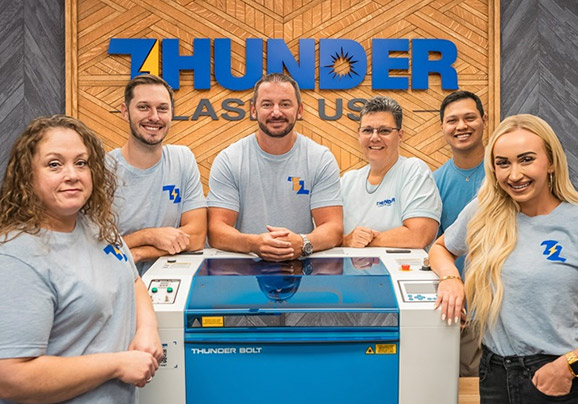
You are not just buying a laser. You are buying the people behind it.
US support, coast to coast, from people who actually run these machines.
When you put a traceability step on a machine, the real question is not just whether it marks clean. It is who is actually in your corner when something goes sideways at 2pm on a Thursday with a build on the line. With Thunder Laser that is a real US-based team, coast to coast, that knows these machines inside out, not an overseas ticket queue and not a reseller who has never run one.
More than a thousand owners have said exactly that in five-star reviews. You start with one free hour of remote training, every machine carries a 2 year warranty, and you get straight answers, including when the answer is no. Buy the machine, and you are buying the team that stands behind it.
See it marked on your own material. Free.
No spec sheet tells you how your solder mask, your anodized enclosure, or your polymer housing takes the mark. So we will just show you. This is a free sample to show what the machine can do, its quality and its detail. It is not a production run, and we do not take in finished goods or fill orders.
Tell us your material
On the short form, tell us your material and the simple mark you want to see, a serial, a legend, a 2D code, or a data plate, within reason, so we can confirm it is a good fit before we run it.
Mail us a few pieces
Send a few pieces of your actual material to our shop. We will send the address. Bare unpopulated boards, blank polymer housings, or a metal plate blank, a piece of your material, never a populated assembly.
We run it and send it back
You get your sample back with the exact settings we used, so you can run it through your own reflow or coat process and verify the code still scans on your own equipment. No cost, no pressure.
Send a few pieces, not just one. Every solder mask color, anodize, and polymer takes the mark differently, so a few pieces give us room to dial it in and show the best the machine can really do.
Only send material you are okay with us using up. Samples are for testing, so treat anything you send as something we may consume getting the settings right. Send bare, unpopulated, nameable material, never populated boards or unknown coatings.
Electronics questions, answered straight.
Will the code survive reflow and conformal coat?
Why won’t you cut or engrave FR4 and fiberglass board substrate?
Will you run my populated boards?
What does the UV do that the fiber and MOPA do not?
Does this make us IPC or traceability compliant?
What power and space do I need, and can I finance it?
Send us your material. We will mark it free.
Fill out the short form and a real person from our team follows up. No pressure, no spam, just a clean mark on your own material and straight answers. Bare unpopulated boards, blank housings, and metal plate blanks only, never populated assemblies.
Prefer to talk it through first? Schedule a sales call.
Not ready to send a sample? Take the guide instead.
Download the guide